Scrooge vs. the Government! Its a UFC (UnFunded Conumdrum) smack-down event! Get it now on Pay-per-view!
uh....nope.
Ah, the spirit of Christmas! Is that what Dickens' Christmas Carol was about?
Maybe.
Dickens was really concerned about the suffering of the poor in the era he lived. The Christmas Carol story is about poor family that has trouble with the basics, including nutrition and access to health care. It was a big problem for industrializing England. It's also about an "upper middle class" guy, Scrooge, who makes a decent living on "Wall Street" - he trades stuff. He has plenty of money and everything he needs and wants, although he is very conservative in his spending habits and his savings just pile up.
The core of the story is the redemption of Scrooge's soul - it's one everyone knows, but there are interesting tidbits.
Initially, Scrooge doesn't give to charity. Why? The sin of greed rules his life. But, what does he offer for an excuse? Essentially, "that's the government's job. That's what I pay taxes for." ("Aren't there workhouses, prisons...etc."). Thinking that way legitimizes holding the poor and needy at arms length. It's neat and clean.
Scrooge treats Bob Cratchit as a rational agent in a labor market, as economists would say. Both of them are free to walk away from their business relationship at any time. Scrooge can fire Bob. Bob can quit. It's not personal. It's just business. This also keeps Scrooge free of messy entanglements of people's personal lives. He doesn't even like the messiness of dealing with others even when he is on the receiving end. Just keep it all neat and clean.
We all know what happens when Scrooge is "awakened". He stops "storing his treasures on earth." He gives to charity, he gets involved in the messy personal life of the people he knows. He starts "storing his treasures in heaven", as the Bible puts it, and life is good. It is worth noting how much and in many ways both the giver and the recipient benefit when this happens.
We have similar issues in 2013. There is lots of noise about greed, and income disparity and "occupying Wall Street." There are issues of people living below the poverty line and poor access to health care.
What's the solution? I ask, "What would Scrooge do?"
Scrooge got involved. He did what he could. Did it solve the whole problem? Of course not. Did he sell all his stuff and donate everything to charity and move in next door to Bob? Nope.
Was Scrooge wealthy? Not really. He was well off, but was certainly not in line for a Peerage.
Did he exhort the government to solve the problems? No. Not even once.
Did he demand the truly wealthy give "their fair share?" No. Not even once.
Why not? Because, all the great things about being human are lost in that approach. The giver and the receiver both gain from charity driven from gratitude. That is all lost when charity is extorted and impersonal.
Bob Cratchit's family could have had a lot of their problems solved if the Parliament had simply extorted more taxes from Scrooge or started selling off the crown jewels and handed the proceeds to Bob's family, et. al.
While there is legitimacy toward "we the people" acting through our government to help solve really big problems, too often we want to do things that way because we are scared, like Scrooge was, to get involved in messy personal stuff. We want to keep the problems at arm's length. It's the easy, cowards way out.
Can we do things that way? Sure. But, nobody's heart would be changed. In fact, it's likely people's hearts would get hardened. You've heard of "class warfare", no?
Imagine "A Christmas Carol" that ends with the Cratchit family getting a government check. Warms the heart, doesn't it?
What if we all did what Scrooge did and just did what we could?
That's the Christmas spirit!
(full disclosure: I don't practice what I preach very well. It's okay to remind me of that.)
Friday, December 13, 2013

Wednesday, October 30, 2013
High Hypocrisy and Stunning Ineptness walk into a bar...
...and the bartenders says, "What is this? A political cartoon?"
If only...
High hypocrisy (or worse) on the right. (Tea Party - go find a mirror, please)
http://www.reuters.com/article/2013/10/29/us-usa-congress-water-insight-idUSBRE99S04Y20131029
Stunning ineptness (or worse) on the left. (Administration, please administer!)
http://www.arnoldkling.com/blog/the-obamacare-suitsgeeks-divide/
and
WSJ: Fixing Procurement Process Is Key to Preventing Blunders Like Healthcare.gov
and (scary-bad no matter which of the three choices you choose to believe)
http://gregmankiw.blogspot.com/2013/10/who-knew-what-when.html
These are all pretty mainstream, middle of the road kind of guys saying these things.
Me? It's clear that we need a good dose of competence and character more than we need ideology, issues or policy.
We need more of this: "Comity is hard to achieve. From a lifetime of experience, I know that most people don’t view Democrats and Republicans symmetrically. In their view, truth and virtue lie entirely with the group to which they happen to belong" (from Mankiw Op-Ed column. Read the whole column, it's interesting!)
and this:

If only...
High hypocrisy (or worse) on the right. (Tea Party - go find a mirror, please)
http://www.reuters.com/article/2013/10/29/us-usa-congress-water-insight-idUSBRE99S04Y20131029
Stunning ineptness (or worse) on the left. (Administration, please administer!)
http://www.arnoldkling.com/blog/the-obamacare-suitsgeeks-divide/
and
WSJ: Fixing Procurement Process Is Key to Preventing Blunders Like Healthcare.gov
and (scary-bad no matter which of the three choices you choose to believe)
http://gregmankiw.blogspot.com/2013/10/who-knew-what-when.html
These are all pretty mainstream, middle of the road kind of guys saying these things.
Me? It's clear that we need a good dose of competence and character more than we need ideology, issues or policy.
We need more of this: "Comity is hard to achieve. From a lifetime of experience, I know that most people don’t view Democrats and Republicans symmetrically. In their view, truth and virtue lie entirely with the group to which they happen to belong" (from Mankiw Op-Ed column. Read the whole column, it's interesting!)
and this:
There is an actual plan! You can read about it here: http://www.fixthedebt.org/. They came up with a framework that's tough, but it works! Both the right and left hate it because it contains things they have sworn they will never surrender, namely entitlement reform and higher taxes (among others).
Well, maybe that's the sign of a good compromise!
You have to give up something to get something.
This situation is not new. Dr. Seuss had it pegged.

Except, we can't just ignore them.
Monday, October 21, 2013
Little Trains - Big Event! (part one)
I like trains. A lot of other people do, too. Why? We just do. Ask us and you'll usually get a rather unsatisfying answer. The real answer is often a bit of an enigma, even to ourselves.
Trains are big, and fast and loud and colorful and do useful, varied work and railroads are complex organizations with complex processes and game-like operations. Lots of things have these attributes, but they are not trains!
The "how did it happen" seems easier to explain. I was exposed at a young age. Most Saturday errands with my dad included a quick stop at the local Long Island Railroad station to watch a passenger train or two go by. At age two, I had decided my life's ambition was to "build a locomovis." I pretty much stuck with that plan through to adulthood! However, I tried this method of indoctrination with my kids and it didn't stick. So, maybe not.
Apparently, it can occur spontaneously. According to Wick Moorman, CEO of Norfolk Southern, "The story I tell, which obviously is probably not true, is that my mother apparently dropped me when I was very young. I landed on my head, and then she picked me up, the only difference was that my brain had been slightly addled and I loved trains. I was always interested in the railroad business and always kind of a railfan, if you will." (Railway Age interview, January 2011)
A typical "railfan" will display much of the following behavior:
1. Find places to watch trains go by.
2. Visit railroad museums
3. Ride tourist trains
4. Take pictures of trains and/or locomotives
5. Ride Amtrak when practical (or even not-so-practical!)
6. Take trips to see trains in other areas
7. Incorporate some "train activity" in family vacations
8. Considers a getting a job with a railroad or volunteering at a railroad museum.
9. Collect railroad related "stuff"/decorate with railroad related themes
10. Have model trains/model railroad
Not everyone does all of these things. Some guys get into the details of the various locomotive models - which manufacture built what locomotive and how can you tell them all apart. They can tell you difference between and EMD SD60M and and SD60I at a glance. Some guys just like to take train pictures, focusing as much on creative photography as the trains. Some guys like model trains better than real ones. Some the other way around.
I like both.
So, when the National Model Railroad Association had their annual convention in Atlanta, I had to go! There's lots going on at the convention. They have clinics on "how to do things" and on railroad history and operations. They also have special interest groups that cover designing and operating model railroad layouts. Additionally, they have tours to local railroad facilities and museums. But, the thing I was most interested in was going on some tours of the best model railroads in the area.
I took a couple days vacation to do this. There were big ones, small ones and ones focused on operating like a functioning, real realroad. Some were focused on capturing a historical era accurately. Some were focused on creating the "railfan experience" in minature, that is providing a setting for watching interesting trains go by. The ranged from "good" to "superb".
Here's the synopsis of what I saw, with pictures.
Pennsy Southern Division
Host Name: John Kelley

FTB RR
Host Name: Ra & Barbara Barr
Live Oak, Perry & Gulf
Host Name: Revis Butler
A supremely detailed and documented layout depicting the first half of the 20th Century in the Florida Panhandle.
Brandywine & Benedictine RR
Host Name: Norm Stenzel
Really phenomenal layout. Fictitious road, but realistic operations and scenery. Lots of visual puns and inside jokes, too.


Trains are big, and fast and loud and colorful and do useful, varied work and railroads are complex organizations with complex processes and game-like operations. Lots of things have these attributes, but they are not trains!
The "how did it happen" seems easier to explain. I was exposed at a young age. Most Saturday errands with my dad included a quick stop at the local Long Island Railroad station to watch a passenger train or two go by. At age two, I had decided my life's ambition was to "build a locomovis." I pretty much stuck with that plan through to adulthood! However, I tried this method of indoctrination with my kids and it didn't stick. So, maybe not.
Apparently, it can occur spontaneously. According to Wick Moorman, CEO of Norfolk Southern, "The story I tell, which obviously is probably not true, is that my mother apparently dropped me when I was very young. I landed on my head, and then she picked me up, the only difference was that my brain had been slightly addled and I loved trains. I was always interested in the railroad business and always kind of a railfan, if you will." (Railway Age interview, January 2011)
A typical "railfan" will display much of the following behavior:
1. Find places to watch trains go by.
2. Visit railroad museums
3. Ride tourist trains
4. Take pictures of trains and/or locomotives
5. Ride Amtrak when practical (or even not-so-practical!)
6. Take trips to see trains in other areas
7. Incorporate some "train activity" in family vacations
8. Considers a getting a job with a railroad or volunteering at a railroad museum.
9. Collect railroad related "stuff"/decorate with railroad related themes
10. Have model trains/model railroad
Not everyone does all of these things. Some guys get into the details of the various locomotive models - which manufacture built what locomotive and how can you tell them all apart. They can tell you difference between and EMD SD60M and and SD60I at a glance. Some guys just like to take train pictures, focusing as much on creative photography as the trains. Some guys like model trains better than real ones. Some the other way around.
I like both.
So, when the National Model Railroad Association had their annual convention in Atlanta, I had to go! There's lots going on at the convention. They have clinics on "how to do things" and on railroad history and operations. They also have special interest groups that cover designing and operating model railroad layouts. Additionally, they have tours to local railroad facilities and museums. But, the thing I was most interested in was going on some tours of the best model railroads in the area.
I took a couple days vacation to do this. There were big ones, small ones and ones focused on operating like a functioning, real realroad. Some were focused on capturing a historical era accurately. Some were focused on creating the "railfan experience" in minature, that is providing a setting for watching interesting trains go by. The ranged from "good" to "superb".
Here's the synopsis of what I saw, with pictures.
Pennsy Southern Division
Host Name: John Kelley
What made this one special was the catenary.
 |
| Nice cat poles and signal bridge |
 |
| Whitford? Yup. |
 |
| Looks like Grif Teller's 1949 PRR calendar painting, to me! |

FTB RR
Host Name: Ra & Barbara Barr
A nicely done garden railroad. FTB stands for "For The Birds". Houses are birdhouses...
 |
| The faithful gather to watch the action |
 |
| Freight rolls by town of bird houses |
 |
| View from the deck |
Live Oak, Perry & Gulf
Host Name: Revis Butler
A supremely detailed and documented layout depicting the first half of the 20th Century in the Florida Panhandle.
 |
| Turpentine production |
 |
| Typical panhandle rural town |
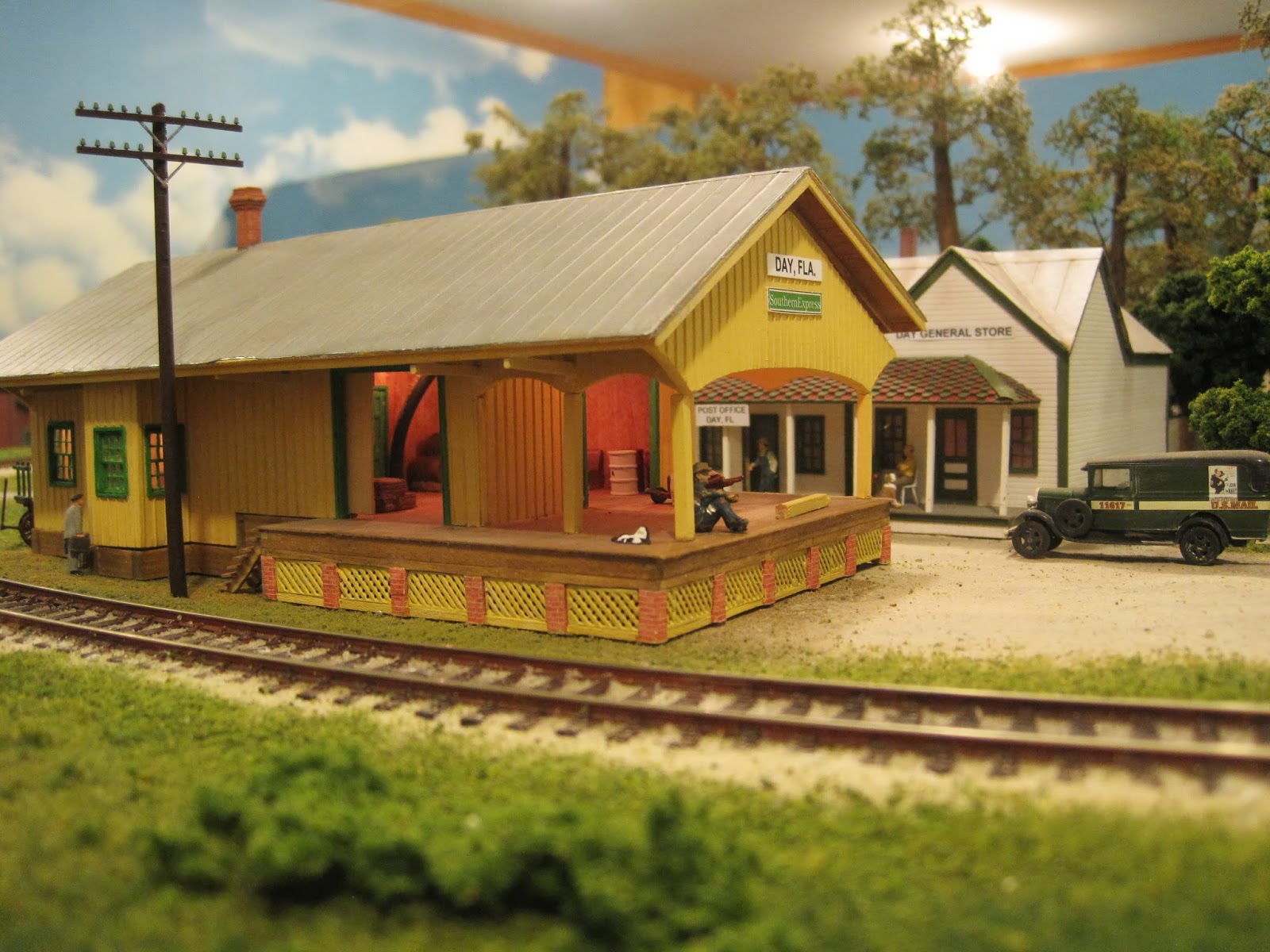 |
| Nice station model! |
 |
| Streamliner |
 |
| Beautiful freight house model |
 |
| ...and tower |
 |
| Early 20th Century... |
 |
| terrific details in this scene |
Brandywine & Benedictine RR
Host Name: Norm Stenzel
Really phenomenal layout. Fictitious road, but realistic operations and scenery. Lots of visual puns and inside jokes, too.


 |
| "Moby Dick" experimental steam turbine |


 |
| Future GE locomotive on display - why not? |
 |
| Nice engine terminal |

Subscribe to:
Posts (Atom)