Thursday, September 26, 2024

Owning an EV - Road Trip!

50 years ago, I graduated High School in South Jersey.  50 years!  ...not possible. 

Anyway, my class reunion was in Atlantic City and I decided to take the Ioniq 5.  I was really interested in what a road trip using fast DC charging would look like.  I had ridden with my sister in her Tesla Y from South Jersey to Buffalo and back and had gotten a good taste of Tesla Superchargers. But, for the CCS world (most all non-Teslae), would it be as easy?

Sheetz in Stephens City, VA


Short answer - yes. 

Here's the long answer.  

The trip is 780 miles total.  I split it into two days, roughly 500 miles on the first day and 230 on the second.  Actual dwell is from my Google Maps data.  Charging time is from charger data that is kept on the charger app on my phone. 

I only used Electrify America chargers because the Hyundai comes with two years of free EA juice.

Here's the data on the trip up.


So, that's 8 stops for a total of 2:44 dwell.  Comparing it to a trip in 2021 in our old Audi Q5, we had six stops for a total of 1:08.  The EV "cost" about 1:30 over the ICE car in this case.  Note that this is LESS than the 1:56 "plugged in" time because a good chunk of that was unattended - getting food, restroom, etc. 

Also, charging at the hotel avoided a trip to "fill up" as the battery charged while the car was parked. 

The trip back.


Sheetz in Wytheville, VA

That's 7 stops for a total of 1:38.  Comparing it to an Audi Q5 trip in 2021 with 5 stops for 1:07, the EV "cost" about 30 minutes. Being familiar with the whole charging routine and never having to wait for a charger helped a lot.  The reason the return trip had fewer KWhrs at fast DC chargers is that I arrived in NJ with about 80% battery, but arrived back home with only 20%.  Having a charger at home makes things easy.

The Hyundai route planner is actually pretty good.  Just pick you destination in the Navigate screen, allow it to include EV chargers, and it'll pick a route and plan the charging stops.  


Done?  Not quite.  Those stops might not be at the charger brand you prefer - i.e. "free" Electrify America - and they might not be soon enough for a "bio-break".  

EA charger at Walmart in Cordele, GA currently has 4 of 4 chargers available


No problem.  First, filter on the charger type you want from the EV screen settings prior to having the navigation system plan the route.  Then, you can see the first charging stop.  Pressing "more" brings up a list.  By selecting "route", the list will populate with all the chargers in route order.  


You can choose one and add it to your route.  The route will replan from there.  I used this feature in lieu of the Rest Stop tab on the maps screen to plan my next stop. 

It worked very well. 

Some other features.  You can see in real time, the number of chargers at the location and how many are available.  This seemed to be very accurate and it did not show "broken" chargers as available.  It doesn't do any en-route prediction like Tesla, because it has no idea how many non-Hyundais might have the charger in their route.  You can get a good idea of how popular your next charger is by watching the available charger number and planning around it with an earlier or later stop.

Other notes.  

I would only charge beyond 80% under two conditions.  Nobody waiting and it would be tactically helpful to my driving.  It's generally not worth it as the charging speed tapers off rapidly after 80%.  At 90% the rate is down to 40-50 KWs.  

With  free charging, I saved over $200 in fuel on this trip.  But, if I'd have had to pay the going EA rate of 56 cents per KWhr, it would have cost me about $200.  EA is on the expensive side, and some of the other networks are much cheaper - something to explore when my two years of free EA is up.

My driving was very much off-peak, yet I had to wait for a charger a couple of times. Hyundai isn't the only car company giving two years free at EA.  I imagine this will get easier as the "free" EA plans expire and the Tesla Supercharger network opens up.  (First quarter 2025 for Hyundai.)  There is a lot of chatter about "broken" chargers.  I found that about half of the locations had one charger down or some part of it not working exactly right.  This is better than I expected - you often see gas stations with some number of pumps down...

The Hyundai and Kia claim is "10 to 80% in 18 minutes" (or 3.9% /minute) ... I came close once at 3.75%/minute. Generally, I managed about 2.7%/min on 350 KW chargers.  How much did that matter?  Not a bit.  I generally plugged in, went to the rest room, came back and was done or only had a few minutes to go.  Hardly enough time to check my text messages!  I really didn't much care if I plugged into a 150 or 350KW charger.

There is a charging time trade off.  If you trip requires X minutes of charging, It really doesn't matter much if you do it infrequently at long intervals or more frequently at shorter intervals.  Twice for 10 minutes is the same as once for 20 minutes.  The difference is the time it takes to exit the highway and get to the charger.  Fortunately,  all the chargers I visited were almost immediately off a highway exit - no more than half a mile.  The winning solution is to time your meal and bio-stops with charging stops.

The need for speed.  

There is a lot of chatter about not driving as fast with an EV because it clobbers the range.  Two facts.  One, speed clobbers ICE car mileage just as badly.  Aerodynamic drag is the cause and the air doesn't care what's driving the car.  The reason is seems so bad in an EV is the EV's regen braking makes non-highway driving so much more efficient.  I typically get about 3.5 miles per KWhr in suburban driving.  I got 2.8 miles per HWhr at 77 mph on the highway.  I'm not slowing down.  My need for breaks exceeds the car's range.

What's next? Eventually, I'll have to investigate actual, paid fast DC charging, but for now, I'm totally satisfied with Electrify America.

Sunday, September 1, 2024

A Sunny Day on Sunrail

 It's been a while since I've ridden a train other than MARTA.  ...and that's not really a train.  It's a heavy rail transit line.

So, I decided to take ride on Sunrail.

Sunrail is Orlando's commuter line.  They purchased most of the route from CSX in the early 2010s, although CSX retains trackage rights.  They started running in May of 2014 and recently expanded up to Deland. It's only about an hour and 15 minute drive from St. Augustine, so it made for an easy day trip.

The route starts in Deland and runs through downtown Orlando, and then south to Poinciana, about 75 miles, one way.  I planned to do a round trip.

I arrived at Deland in time for the 9:40 departure.  There were ticket machines on the platform and a Sunrail "ambassador" there to help you purchase and validate your ticket.  A Senior round trip the length of the line cost $4.75.


My train arriving from the south at Deland

The standard train consist is an Morrison Knudsen MPI MP32PH-Q which is a 3600 HP, HEP equipped (separate engine generator set to power lights and HVAC on train) rebuilt MARC (Maryland commuter agency) locomotive plus two coaches.  The coaches are Bombardier bi-levels which are used on may commuter trains in North America.  Each coach seats about 140 people.

Changed ends and ready to depart as train #317

The trains run with the locomotive on the north end and a cab car on the south end.  All they have to do at each end of the line is have the engineer walk from one end of the train to the other.  

Most of the station stops on the north side of town had a dozen or two riders get on and off.  The train  seemed to be a quarter to half full most of the time.  

Deland has always been an Amtrak stop.  So, there is a waiting room and and restrooms here.

The new Sunrail platform adjacent to the Amtrak station.

I grabbed the "railfan" seat behind the operator's cab in the cab car.

Meeting a northbound at DeBary

Crossing the St. John's River near Sanford

Approaching Amtrak's Sanford Autotrain terminal

Rush hour service is about every 30 minutes, with hourly service between the rush hours.  Total time to cover the 75 miles is about 110 minutes (1:50).  Top speed is 79 mph with lots of 70 mph curves and some 30 mph running through the heart of Orlando proper.  Most of the route is double track.


Rolling into downtown Orlando

Amtrak's Orlando Station

Sunrail shares four stops with Amtrak, Deland, Winter Park, Orlando and Kissimmee, making them a good first/last mile choice for Amtrak passengers.

CSX still has a freight presence in Orlando

Oh...  This happened.  As we're rolling along past a CSX yard with an automotive ramp, a CSX was train yarding, so I start shooting a video.  Look down the track.  A truck thinks the way is clear once the freight train clears and heads across the crossing. He doesn't look for or see our train closing at 80 mph.  He doesn't have a place to go on the other side.  So he stops.  On the crossing.  Uh. oh.   


I'm about ready to bug out to the middle of the coach and stop shooting the video just after I say "Holy crap!"  The truck starts moving.  Everyone exhales as it clears.  


The engineer says he was about 3 seconds from dumping the air.  It would have been too late.  We'd have hit.


Looks more like concrete and steel to me...

End of the line in Poinciana 


Factory in Poinciana.  Is this where they make all of it?

Upper level of coach.  Many seats have nice tables between them.

Lots of running at MAS!

Some CSX yard locomotives
Arriving back into Orlando
A rare, pristine box car.  

Church Street is a stop.  It was an up and coming downtown hot spot 35 years ago.  Not so sure, now.

Nice looking city-scape.  Not so sure much is happening...

The central bus station for Orlando's Lynx bus network.  Was fairly busy. 


MP 750 - from Richmond on the Seaboard Airline Railroad?   Nice landscaping at Deland station.


Train set lays over on stub siding at Deland.

They don't want you on the Amtrak low level platforms unescorted.  A bit much, I think.

Ready for next run to Poinciana.

So, Orlando is a city that grew up on automobiles and freeways at a fierce rate in the past 50 years and now has fierce traffic. They are just starting to get the idea that continued growth and controlling the rate that traffic gets worse depends on frequent, reliable transit.

Sunrail is a good start.  I give them high marks for fast, reliable, comfortable service including good off peak service.  They do a good job of connecting and explaining what's interesting at their station stops.  Many are near small, functional downtown areas with restaurants and shops.   It appears that some high density housing has located near some of these town centers along the line.  More points for handling bicycles - there are adjacent trails and are a decent first/last mile at many stops.

They get points off for not having any weekend service. 

The fares are extremely low and likely why the ridership off peak is pretty good and why the subsidy is rather high.  

All in all, I really enjoyed the ride, less the "near miss", and will definitely not hesitate to use it again...maybe to the airport with a short Lynx bus ride, to sample a Brightline trip!


Wednesday, August 21, 2024

Biking the Erie Canal

A few things are true. 

1. After doing the GAP trail two years ago, I really, really wanted to do another bike tour. 

2. New York has nearly completed a trail along the entire length of the Erie Canal. 

3. Canals are water level things, so canal trails should be easy pedaling. 

 So, I hunted an Erie Canal tour to do. By the time I got busy looking, a whole bunch of supported tours were sold out! However, I found Senior Cycling still had space for theirs, so I signed up! ...and got my sister to come along.

This trip started at Niagara Falls and ended in Palmyra NY, about 25 miles east of Rochester.  There were five days of pedaling.  Three along the canal, and two out-and-backs to Lake Ontario.

Here we go!

For starters, this is a tour that's fully supported by two guides from the area who led us some days and swept up after us on every day.  There were 13 riders in the group, about half came with their own E-bikes and the other half rented gravel bikes from the tour operator.  Surprisingly, the E-bike riders did not ride as fast as the rest of us...

Day Zero.  We arrived at Niagara Falls and there was a group dinner at a nice restaurant a block from the falls.

US falls

Tesla girl and Tesla himself!


Jane and I took a peek at the falls after dinner.

Day one was a ride along the Niagara River down to Lake Ontario.  36 miles or so for the round trip.  Most of this was on a trail, but some was via some town streets.  They led us down, but let us return at our own pace.

The first stop on the day's ride

The Senior Cyclists

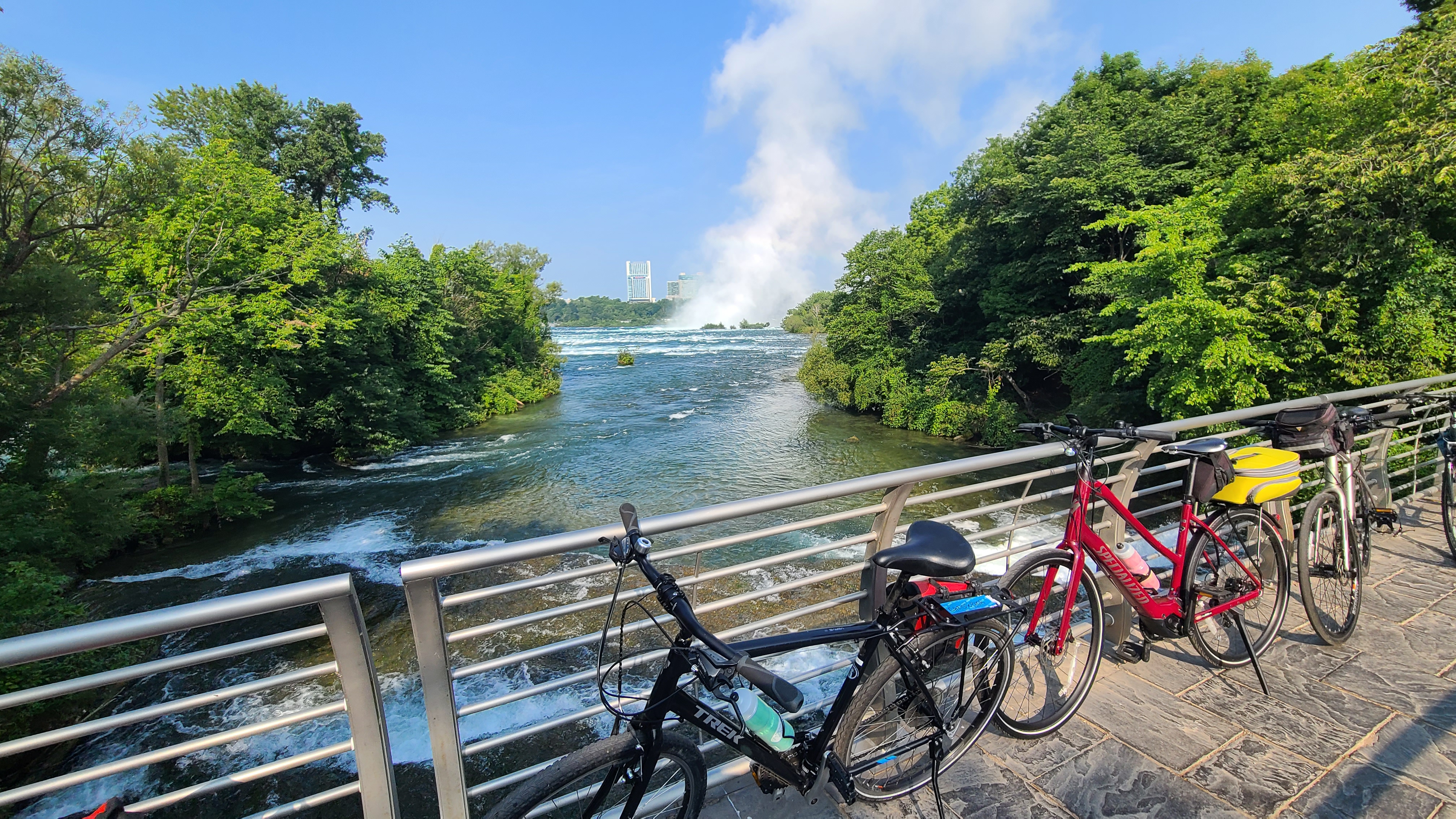
Mist from the falls

Canadian Falls

Maid of the Mist heading in

US falls in foreground, Canadian in background

Similar view in 1959 - I was 3!


Trail along Niagara River

Whirlpool

Lunch at the Lake

We pedaled back through Youngstown and stopped for ice cream.  Some War of 1812 action occurred here.


Really good frozen custard!

Dinner was on our own.  We went to Niagara Falls branch of Anchor Bar (of Buffalo).  These guys invented Buffalo Wings. We has some.  They were good.


Day two.  About 34 miles. Tonawanda to Medina (pronounced Med-eye-nah.  Really.)

They loaded the bikes up on the trailer and carted us out to Tonawanda to start riding the canal trail.  The first few miles were not promising.  The trail was mostly paved but bumpy and walled in from the canal by vegetation.  Not much to look at.  Lots of work picking your path along the trail.  Things got much better as we approached Lockport as the trail was fairly new, had a good views of the canals and was easy to ride. 

Lunch was on our own at Lockport and we spent some time view the locks and learning canal history.

1912 - current canal locks on the right.  1862 version of "flight of five" locks on the left

What an original circa 1825 canal boat looked like.

The original five locks were required to get canal up the Niagara Escarpment.  There were originally two sets. One set was replaced in the 1912 modernization (locks on the right)

Statues of 19th century lock keepers from a photograph.

Current canal is used by pleasure boats, primarily.

Here's the short history of the canal.  The original canal was four feet deep and forty feet wide and was so successful, it quickly became clogged with traffic and very hard to maintain.  By 1862, the canal was widened to 70 feet and made seven feet deep and remained a successful freight corridor..  By 1900, the canal was obsolete, having been eclipsed by the railroads.  But, in the early 20th century, the canal was completely rebuilt to accommodate large, motor propelled barges large enough to compete with railroads for freight.  It was now 120 feet wide and 12 feet deep.  This is the canal that exists today, although all the freight traffic dried up after 1960 as the St. Lawrence Seaway opened.  It's primary use is recreational boating.

The "tow path" the trail is on, is actually just the berm of the canal.

Typical canal path east of Lockport


1912 modernization included standard lift bridges over the canal.  Most still remain.


Lodgings in Medina


Day three  Medina to Rochester.  About 48 miles.

Some scenes of Medina.  A sizable town between Niagara Falls and Rochester.  


Medina is in apple country

Building at left is 1860's Opera House

At one point, the canal goes over a road.


Lift bridge in raised position


Arriving lunch spot Jane in the lead.  Me following.

Another lift bridge en route to Rochester

One the way to Rochester, after lunch, we stopped for ice cream in Spencerport. It was good that we stopped as it gave time for a thunderstorm to slide by us to the east without having to get out our raincoats.

Stopping for a look at where the canal crosses the Genesee River

Canal straight ahead.  River flows right to left.


Day Four - Rochester to Lake Ontario and back via Genesee River.  About 28 miles

Breakfast each day was a bit of an adventure.  The tour leaders seemed to favor greasy-spoon diners. No shortage of calories for pedaling!  (I worry about diners with "good food signs.  "Great food" is a bridge too far!)

Rochester from the Genesee River

Heading into the city

Stopping for a look at Interstate bridge

Group shot.  Show-off in tree.

Rose garden in park along route

Genesee River  still has lake boat service.  Cement being unloaded.

Beautiful causeway across a marsh on the Genesee


At Ontario Beach Park

View from the jetty

On the way back, a view of the Lower Falls on the Genesee

...and the Upper Falls in Rochester, proper

Downtown Rochester along the river


Group dinner was in old Lehigh Valley train station, now a Dinosaur Barbeque.

Art Deco do-dad on building

Day Five - Rochester to Palmyra.  A half day.  About 26 miles.

Leaving Rochester, the trail was paved and easy riding
Breakfast was in nice restaurant in Fairport.  Less than 10 miles from our start.  This is the view from the outdoor seating.  Old grain elevator on the canal converted to lofts.


Railfan platform and Conrail caboose in Fairport.  Worth a quick look!

The day ended with lunch in Palmyra.  Old canal and stone arch road bridge.

New locks at Palmyra

Restored standard canal bridge from 1860 canal modernization


Cast iron design was state of the art, then.


Then, it was back to Niagara Fall in the van. It was a really good trip.  Well run.  Good accommodations.  Would I do a Senior Cycling trip again?  Qualified "yes."  For contiguous trips where all lodging is right adjacent to the trail, you don't really need full time, on site leaders and support - just someone to tote your luggage and give you a ride back to start.  But, where there is ferrying to and from trail segments and lodging, these guys do a good job.  I can recommend!

The Erie Canal trail is generally a wonderful thing!  I really want to try another segment.  Maybe some day trips on the east end?