Monday, February 20, 2023

Just stop it! Train brakes.

 Once again, everyone with an internet connection has become an expert at train braking systems and why or why not they would/could/might have helped avoid the latest derailment disaster.

I'm here to help!  First of all, I know a good bit about he basics of train braking, and a good bit of history, but I'm not an expert, by any means.  Every railroad has an expert or two whose only job is brake equipment.  I was not one of those guys - God bless'em.  But, I did rub shoulders with them from time to time...

So, lets start out with some history and basics.

Once upon a time, a train was a locomotive and a few cars.  The steam cylinders and drive rods made it go.  A lever with a shoe that pressed against the driving wheels provide braking.  The might be able to slow down a bit faster than it accelerated, but not much.

Trains got longer and had couplers so you could add and subtract them from the train.  Locomotive brakes weren't enough, so they added brakes to each car.  A man would walk along the top of the train and apply the brakes on the cars, as needed.  

Clearly, this wasn't a great way to control trains, particularly as trains got longer and heavier.  The brakemen would fall off trains, get clobbered by bridges and tunnel and trains would occasionally run away down hills if braking was insufficient for the grade.


A solution for better train braking was needed.  Many patents were filed.  Enter Mr. Westinghouse.  He invented the train braking scheme that is in use to this day.

It did two things.  Provided power for braking.  Provided centralized control of braking. The genius of it was it:

1. did it with a single air line running the length of the train providing both the power and control in one

2. stored the energy to power the brakes on each car

3. was fail safe as the brakes applied if the air line was broken

4.  did it simply with a single air valve, an air reservoir and a brake cylinder on each car.

Simply, you pumped up the whole train, filling the reservoirs in each car.  When you wanted to apply the brakes, you let a little air out of the air line (called a brake pipe or trainline).  This caused the valve on the car to send some air from the reservoir to the brake cylinder.  The more you let out of the brake pipe. the more braking you got.

When you wanted to release the brakes, you pumped the brake pipe up and the brakes released.

The control was a valve in the locomotive.  The locomotive had to have a compressor and an air reservoir to feed the brake pipe.

You can see that if the train were to break in two, all the pressure in the brake pipe would be gone and the whole train would have maximum braking applied.  The inter-car connectors for the air hoses between cars,  a.k.a "glad hands",  were designed to slide apart if the cars were uncoupled and separated.  

Great!  Problem solved!  We're done...

Not so fast.

There were all sorts of improvements made over the years to make the air brake system work more reliably, improve safety, and allow longer, heavier trains as technology and material improved.  Still, the system leaves a lot to be desired.

The two big drawbacks of the air brake system are the co-mingling of the power and control signal.  Trying to send a pressure wave signal down a long, winding pipe of pressurized air that already has some flow in it due to many small leaks, is difficult.  The pressure wave signal has to be be big enough to be seen by every car in the train but not too big to tip every car into emergency braking (improved emergency braking is one of the big improvements made over the years).  You can only let air into or out of the trainline at a controlled rate, through the valve on the locomotive.

The other is the speed of sound.  The fastest you can get a pressure wave to propagate is the speed of sound - about 1000 feet per second.  So, on a 10,000 foot train, that's 10 seconds front to rear.  Add in the damping in the brake valves and friction in the braking rods and levers and it takes even more time to develop full braking pressure of the brake shoes against the wheels.  

Freight car couplers are attached to the car's frame by a spring (usually made of rubber pads) in order to allow them to couple to each other without damaging the car.  The distance the coupler can travel forward and back on the car is called "slack".  When you start pulling a train and stretch it, the slack "runs out", when the train is pushing on the locomotives, the slack "runs in".  Controlling the slack when running a train is one of the hardest parts of an engineer's job, particularly where the terrain is undulating.   When the brake are applied, they actuate from front to rear and the slack will tend to run in.  If it runs in too hard and fast, it can actually cause a derailment in certain cases.

On top of this, add that rarely does a the car's braking system know if the car is loaded or empty, so it is calibrated to assume the car is empty so the wheels don't slide when the brakes are applied. It takes a long time and a long distance to stop a freight train.  

Yet, despite these flaws, the system has worked well and reliably.  

But, in the past several decades, technology has pushed ahead and an opportunity to improve train braking appeared to be possible.  If you sent the signal to the brake valve electronically with a speed of light signal - 186,000 miles per second instead of as a pressure wave in the trainline, you could get all the brakes to apply at the same time, right away.  This would make trains stop faster and with greater easy.

All you have to do is put a microprocessor and an electrically activated valve on each car.  

Simple, right?

No.  Remember, there is:

1.  no power on the freight cars to operate the microprocessor and the valve.  

2. no wire running through the train to send the signal.

Where is there power?  On the locomotive.  So, the best solution seemed to be run power and signal from the locomotive to each car.  In order to get enough power to every car, it turns out the voltage needs to be over 200 volts.  That's a lot.  And, the control signal has to run down this same wire.  And, I need a connector between each car that can pull apart without damage and make and maintain a solid connection in the rail, snow and dirt of a railroad environment.   Not an easy task.

But, every journey starts with the first step.  In the early 1990s, the supply industry started developing some hardware and the railroads started running one or two test trains with the new ECP braking systems.  Because the equipment isn't compatible with regular airbrakes, entire trains and their locomotives had to be retrofitted for the test.  Railroad run some trains of single commodity, like coal, that run back and forth between shipper and consignee without uncoupling and cars.   These are called unit trains and this is where the ECP braking systems were tested.

The good news, is they worked - superbly.  Braking distances were cut roughly in half.  Train crews talked about the responsiveness as being "sports car like".  This virtually eliminated the risk of derailments from slack running in and out.

The bad news was, lots of teething problems.  Most notably the connectors.  Carrying 200 volts down the length of the train with enough current to operated the valves caused a lot of burnt connectors.  This was especially disconcerting because the connectors weren't being plugged and unplugged.  They were being left alone, for the most part.

So, the supply industry started to improve the hardware and the railroads increased the number of test trains from one or two to a small handful.  The improved hardware made regular service on unit trains look feasible.

Here's a look at the state of the art equipment:  

https://www.wabteccorp.com/digital-intelligence/electronics-and-components/ecp-4200

So, what happened?   Why don't we have this stuff on every unit train now?  A few reasons:

1.  Current air brakes are cheap, supremely reliable hardware and flexible - same for all railcars and locomotives.  Running some trains with and some without is difficult from locomotive fleet perspective.

2. ECP braking is somewhat costly to disruptive to apply.  Cars have to be out of service.  People have to be trained to operate and maintain. 

3. Many trains, particularly unit trains, are run with privately owned cars.  Getting them to accept any additional cost is problematic.  It was like pulling teeth to get them to agree for $40 a car for automatic equipment ID tags.

4. About the same time ECP was gaining momentum, the industry was disrupted.  A model where railroad operations are leaned out, eliminating any resources not needed to just run the optimized operating plan, too hold and spread to all railroads.  This model is called Precision Scheduled Railroading or, PSR, and needs it's own blog post to explain.  However, PSR made it extraordinarily difficult to spend time, human and material resources on advancements.  

Meanwhile on the oil patch...  Fracking started making crude oil available in new places.  The only practical way to move it was by rail.  A lot of this oil was not de-gassed, meaning the tank cars hauling it were very flammable.  A few spectacular derailments and fires got the FRA's (Federal Railroad Administration - US DOT) attention.

They, and the NSTB were frustrated at the lack of development of ECP braking and saw that some of the derailments would have been less severe if the trains had ECP braking.  So, a regulation to equip these trains with ECP was put forward.  The railroads fought it for the reasons listed above.  Money, time, effort, minimal or no hard economic benefit.  And they eventually prevailed and got the regulation withdrawn. 

In my opinion, the railroad's fight against the regulation is both justified and unjustified.  It is justified because the "power from the head end" style of ECP braking is a terrible idea.  Higher voltages are dangerous and the connectors maybe okay for unit trains, but will be a horrid mess once you try to apply this to cars that are coupled and uncoupled a couple times a day.  Technology now includes several ways to power a freight car that didn't exist when this path was chosen in the late 1980s.  There are solar panels, generators that can be incorporated in axle bearings, and small air turbine generators now that didn't exist then.  

In fact, there are specialized trains that have solar panels, microprocessors and automated unloading gates on them for dumping ballast on the tracks. The end of train devises that monitor the air brake pressure, display a flashing light and have a valve for actuating the brakes, have a small air turbine to charge the battery.

I think each freight car should have it's own power supply and storage battery to power the ECP braking system.  This is an area where there needs to be some development effort before a solid standard can emerge, however.

The data trainline to send a signal to the brakes becomes simpler once the power supply requirement is removed.  In fact, it might not have to be a wire at all.  Why not something like directional Bluetooth?  The trick is that each car can only "talk" to it's neighbor, not the car on the adjacent track or two cars ahead.  Another thing that would require some development. 

But, it would all be worth it.  Once you have freight car with a brain and power supply on it, you can do all sorts of beneficial things.  

You can monitor the car's health.  Some possibilities, on board bearing temperature and detection.  Car suspension issues - rocking, bouncing, hunting.  Wheel defects - hollow tread, thin flange, out of round.  Fatigue life management of coupler and draft gear. This should reduce the incidence of mainline derailment due to equipment condition many-fold.

Also some operational and commercial stuff.

Lading condition - temperature, pressure, leaks, forces on lading with real-time feed to customers. Greatly reduced time for trains to add and drop cars - "pumping up" the trainline is through a wide open feed at full main reservoir pressure instead of through a choked feed valve.  

Best of all, you can monitor and manage braking force by reacting to incipient wheel slide.  This can greatly reduce braking distances.  Stopping in 2000 feet from 60 mph should be doable.

So why isn't this happening?  

The biggest one is no one has been able to provide leadership that leads down the implementation path. Managing through the change from standard to ECP braking is fraught with problems.  Should cars have both systems for a while?  That's expensive and hard to manage.  You'd need a valve to cut one system in and the other out .  Where is the interface?   Every car would have to have ECP before you could run and ECP train.  Do you leave a few unequipped cars behind or what?  Every railroad has to take the same path at once - in all of North America - like gauge and couplers and airbrakes(!) in the 19th century.  And what of those pesky private cars owners?  They are about 1/3 of all the cars in service.

The usual path for improvements is that they have to provide hard savings.  Many of these things have hard costs and soft savings.  Railroads have, by their own choices, decided not to invest in technology with soft savings.  Large organizations tend to think this way. They often need to be pushed.

Conclusions:

1.  Railroads made a big mistake failing to continue to push ECP braking, being more interested in PSR and mergers and takeovers.  Being distracted by Wall Street is no excuse.  You need good leaders to sell what's important to the Street, not the other way around.   After all, CEOs get paid a boat load just for this.

2.  The current state of the art is already outdated.  Might as well start fresh and try to develop a more up to date and robust system.

3.  The railroads have the money, but they might need to assemble a sizable team, with good participation from the trade organization (AAR) and goverment (FRA).

4.  The time to get busy is now.

Friday, December 16, 2022

Appenzell - You are weird...and wonderful - Part 1

Luggage schlepping reprise....

We scoot back to Zurich on Wednesday and make our way to the Hilton near the airport.  The idea is that it will be easy to get away on Saturday morning.  They have a shuttle, so no baggage schlepping will be involved.  

...maybe...

We take the train to the station that is under the airport terminal and find our way to curbside to arrange for our shuttle to the hotel.  

...except...

The shuttle doesn't run for a couple hours in the afternoon.  We'd have to wait two hours.  What's plan B?   A taxi.  $20.  $20!?!  Don is cheap.  Plan C?  Get out the SBB app!  A tram from the airport, then walk a half a mile - and save $20.  Forgetting my "no schlepping" pledge, I talk Patti into it.  "How hard can it be? I say.

Find the tram at the airport.  Easy?  No.  We hunt for signs and finally figure it out.  Buses and the tram leave from the same outdoor plaza.  

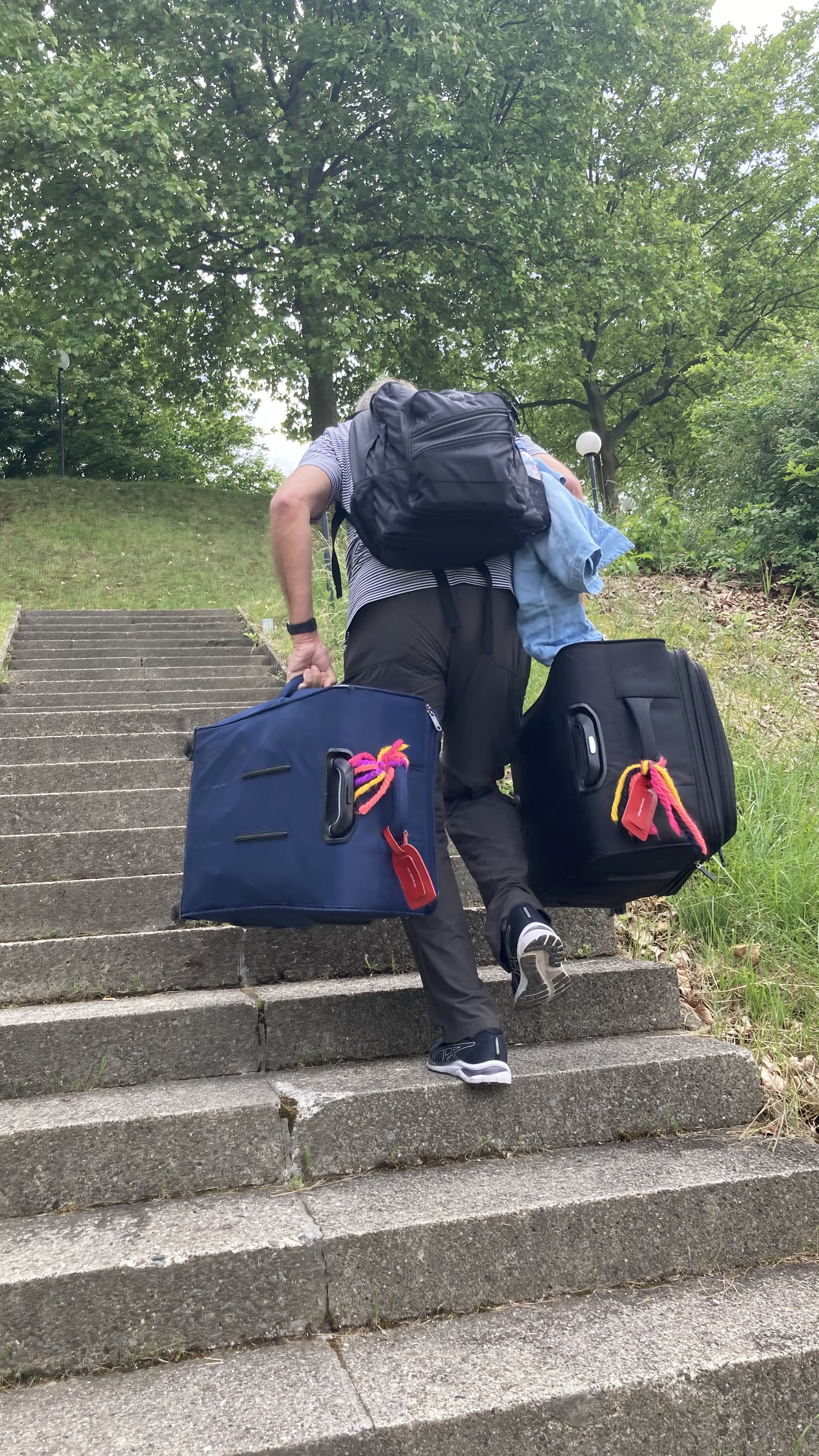
Get on the tram with our bags.  Ride one stop.  We can see the hotel.  A railroad, a highway and two industrial parks are in the way.  We start walking.  Blocked.  Double back and get around the railroad.  Walk through an industrial park.  Blocked.  Take a different route.  Find a highway overpass.  Carry bags up and over.  Finally arrive at the hotel.  Four flights of stairs from the street to the lobby.  Patti is done with my foolishness...so I "gladly" take both bags up the stairs.  That $20 taxi is looking like a bargain, now!

Slow learner schlepps.

We get checked in.  First thing we do is book the shuttle back to the airport for Saturday morning.  Next, we head back to the airport to catch a train back to Zurich.  This time, we figure out how to take the bus.  Much easier.  Much, much easier without luggage.

We make sure we know the location where I can get my Covid test and then took a look around the state museum.

Old room preserved at museum


Thursday, we decide on a day trip to the Appenzell area of Switzerland, with two destinations in mind.  One is a trip up Ebenalp on a cable car and a short hike to a restaurant built on a ledge on the mountainside.  The other was the town of Appenzell itself.  Most of Switzerland we'd seen so far was dominated by the Bernese culture.  Appenzell is different.  It's in the east, close to Austria and is different in many ways.  

But, first Ebenalp.

Bus to airport, train to Ebenalp.  

Train to Ebenalp.  We changed trains here, at Gossau.

Arriving Ebenalp

Cable car is right across a stream from the train station

We head to the cable car station and buy our tickets to the top

On the way up!

Thankfully, not a busy day!


Passing the cliff with the trail on it.

At the top.  Note the dark clouds on the horizon...

Not quite the happy hiker.  Too many sheer drops!

The trail goes through a cave.

The cave was once inhabited by pre-historic people.

Cave exit

The trail also included a small chapel.

Along the trail to the lunch spot!


The restaurant...and the view

Our table inside

Appenzell is known for it's brewery.  So I order an Appenzell.  What I get is Appenzell schnops!  They are also known for that! 

Appenzell schnops - a double shot!  That'll warm me up!

But, I wanted the beer.  So, I had that, too!

Beer!


And some lunch!

As it turns out, we would need something to keep us warm...

12 C is 53 F.

and dry...  Remember those clouds on the horizon?  They moved in!  Time to get going!

Not quite the view we had half an hour ago...

Heading out.

Too late!  It's pouring!  Thunder and lightening, too, near the end.  We run up the trail, through the cave,  back to the cable car station.

Rain!

We dry off in the cable car station and wait for them to start running again.  They'd stopped running due to the lightening.  

By the time we get to the bottom, the rain had stopped.

We get the next train and head to the town of Appenzell, but when we arrive, it's pouring down rain again.  We catch the next train headed back to Zurich.

The sky was unsettled all day.  The view from our hotel that evening.

Tomorrow is "go get a covid test day"...and go back to Appenzell.  

Saturday, December 3, 2022

They've been working for the railroad - how does that work?

 Somehow, like everything else it seems, railroad labor agreements have become politicized.

And, it seems most people who have an opinion, are ignorant of how it works.

This is a brief - super simplified - explainer.  WARNING - I'm simplifying, glossing over and ignoring A LOT!

You have a railroad that goes from A to B to C.  You run four trains a day in each direction.  Two of them stop at B.  You need an engineer for each train.  Each engineer can only work 12 hours a day and then has to have 10 hours off.  That's 10 hours uninterrupted. And, you have to give at least 2 hours notice for the next job.   

It takes 10 hours, normally to get from A to C without stopping.  The train that stops at B takes 13 hours, so needs two crews to get from A to C.

The trains that run across the railroad get their engineers from pools.  There will be so many slots in each pool.  

Lets use the A to C train to figure out how many slots we need in the pool.  

There are two pair of trains.  Lets have train AC1 leave A at 8 AM and arrive C at 6 PM.  Train AC2 leaves A at 8PM arrives C at 6 AM.  Lets have the return trains running on the same schedule.  Train CA1 leaves at 8AM, Train CA2 at 8PM.

The first engineer takes train AC1 at 8AM on Monday, arrives at 6PM.  Gets 10 hours of rest and is ready at 6 AM, and takes train CA1 back on Tuesday and is ready for AC1 again on Wednesday.  

It appears I can run both pair of trains between A and C with two engineers.  So, I'll put two slots in that pool for that train.  Similarly, trains AC2 and CA2 need two slots.

But, wait!  What happens if something goes a bit wrong.  What happens if one day, I can't start train AC1 on time because a locomotive broke down or there was a connecting train from another RR that arrived late?  If one train gets a late start, then that engineer won't be ready on time for his train coming back after his rest.  Better toss another slot in the pool, just to be safe.

So five slots for that pool.

Over two weeks, if everything happens by plan.  Pool slot #1 highlighted.


Here's what it looks like to the person who "owns" pool slot #1


Some things to look at here.

1) notice that the person goes to work two times at 8 AM, then the next two at 8 PM.  This is worse than having to work a week of "nights" and then a week of "days".  People have natural circadian rhythms of awake and sleep.   This kind of work schedule goes against nature.

2)  notice that there are 26 hours every time the person is at home. That's a "day off".  So this person works two days, then has a "day off", then works two more.  Every time at home, his job start alternates between 8AM and 8PM

3.) notice that there are 12 trains operated ("starts") every two weeks.  So, the person will get paid for 12 trips every two weeks and have two "days off".


The extra board

What happens if one day, there are too many cars for train AC1 and you have to run a second AC1 today?  Or if the CEO shows up with his special train and needs to go from A to C?

What happens if this person gets sick, has to go to the dentist or schedules vacation?  Or just plain needs a personal day off?

The railroad will hire, qualify and keep enough engineers to fill all the pool slots plus staff an "extra board".  That's a pool of engineers than can fill in for any pool slot or work any engineer job in yards A, B and C.

You call a person from the extra board to work these irregular occurrences.  

"Marking off" - taking a day off

The assumption always has been that engineers want to make as much money as possible, so they would "mark off" relatively infrequently.  The railroad would let them do it as needed - generally as long as it wasn't "excessive".  If it was, the Road Foreman - the engineer's management supervisor - would have to have a talk with the engineer.

Time "marked off" wasn't paid - except for scheduled weeks of vacation - which had to be planned ahead and approved.

The way it was.

This simple plan outlined above would have been a perfectly legal work schedule 20 years ago.  

It isn't now.

The hours of service law was changed about 15 years ago to require two days off after 5 in a row.  A day is any part of a calendar day.  So this person is working every day.  

To be legal, it would have to look like this: (strike thru for days required off)


So, now this person only gets 8 starts every two weeks instead of 12.  The railroad now need to fill this pool with 3 people where it used to need 2.  So, instead of 5 slots, they need 7 or 8.

In the "real world" there are trains that don't run 7 days a week and trains that run irregularly depending on demand, like coal trains, so pools rotating with required 2 days off every 5 probably don't need as many extra slots as this example.

You can also see that a person might be able to predict their days off, but in practice things happen and prediction more than a day or two ahead really isn't  possible.  

Since the person now gets two days off for every 5 worked, the railroad became VERY RELUCTANT to allow people to "mark off" when they needed.  Many implemented strict attendance policies and enforced them harshly.  

But, the Budget and PSR!

So, let's review.  The hours of service law changes imposed a cost on the railroads - they had to create and fill more pools slots.  It also made it difficult to fill yard positions that are 6 or 7 day a week jobs.

No more 7 day a week jobs and just fill with extra board when the person needed a day off.   Crew scheduling became more difficult and expensive.

But, there was great pressure to NOT let it be more expensive.  You're running the same amount of trains, but you need more people, and people have a fringe cost that's pretty high - health care and paid vacation being the top two.   So, the railroad managers trimmed their pools and extra boards to fit the "top down" budget they were given.  As long as things ran fairly smoothly, this worked out okay.  

But!  ...and this is a big But!  Something called PSR appeared.  It stands for Precision Scheduled Railroading.  The goal of PSR is to create an operating plan that requires the fewest resources - crew, locomotives, yards, etc. - and then run that plan rigorously.  It includes trimming those resources to just fit that plan.  

The railroads laid off all the "excess" engineers.

This can reduce costs a good deal more, but leaves very little slack for when things go wrong.

To the employees, no more "marking off" as needed.  You had to work when you were called.  Period.

Everyone is unhappy

What happened next is a mess.  Railroads could not execute their PSR plan reliably - that would take a whole 'nother blog post to explain.  But, it caused congestion, slow operation and meant the railroad was short of engineers just to be able to operate in congested mode and way short of what would be needed to dig out.  But, even in this condition, the railroads were generating tons of cash and somewhat reluctant to increase spending.

But, the congestion made the railroad customers very, very unhappy and management reacted.  The RRs went to call back the engineers they laid off at the start of PSR.  Few came back.  Why?  Who wants a job where you work uncertain start times, have uncertain days off and are away from home half your nights?  Many found other jobs they liked better.

Operating way off plan made the engineer's jobs even worse and they became supremely unhappy. It took them longer to get over the road with their trains - with no extra pay.  It meant start times and predicting days off were nearly impossible.  Need a day day to go to the dentist?  It goes on your attendance record!

Negotiate.  Time for the next contract.

Railroads are weird when it comes to labor relations.  They negotiate nationally, not by each railroad company.  It is written into law this way because there used to be hundreds of railroads and EVERYTHING used to move by train.  One RR going on strike could gum up the whole works, national agreements were the only way.  Congress made it law.

The railroads form a "National Carrier's Conference" to negotiate with the national trade unions. 

There were occasional national strikes, but the law also allowed Congress to mandate the solution, so the strikes were never longer than a few days.

The latest round of talks was against this backdrop of congested, under-staffed, hugely profitable railroads and rail employees with longer work days, almost no control over their start times and no control at all over their days off.

The current round of negotiation got stuck on the issue of days off.  

Since the "five days on, two days off" law the employees had moved from being able to "mark off" almost as needed to never really knowing when their days off would be much in advance.  With less control over the amount of work they could do, it was more of a hardship to take an unpaid "mark off" day - even if management didn't have a strict attendance policy.

So, the employees wanted some paid "sick days".  

The railroads, who were still "hand to mouth" trying to operated trains to their plan, couldn't afford more days off from employees.

And, there is sat.  Until the unions and railroads agreed on one day a year, paid time off.  ONE.

The engineers (and conductors) who were already supremely unhappy, weren't exactly thrilled and said NO!  But, they knew it was really a long shot that anything would change.  They knew there was little chance they'd be allowed to strike very long, if at all, and that Congress would most likely impose the agreement they just voted down.

Is it fair?   There's lots that's unfair and stupid about how RRs and labor and government go about things.  I'll save that for later.