Wednesday, August 21, 2024

Biking the Erie Canal

A few things are true. 

1. After doing the GAP trail two years ago, I really, really wanted to do another bike tour. 

2. New York has nearly completed a trail along the entire length of the Erie Canal. 

3. Canals are water level things, so canal trails should be easy pedaling. 

 So, I hunted an Erie Canal tour to do. By the time I got busy looking, a whole bunch of supported tours were sold out! However, I found Senior Cycling still had space for theirs, so I signed up! ...and got my sister to come along.

This trip started at Niagara Falls and ended in Palmyra NY, about 25 miles east of Rochester.  There were five days of pedaling.  Three along the canal, and two out-and-backs to Lake Ontario.

Here we go!

For starters, this is a tour that's fully supported by two guides from the area who led us some days and swept up after us on every day.  There were 13 riders in the group, about half came with their own E-bikes and the other half rented gravel bikes from the tour operator.  Surprisingly, the E-bike riders did not ride as fast as the rest of us...

Day Zero.  We arrived at Niagara Falls and there was a group dinner at a nice restaurant a block from the falls.

US falls

Tesla girl and Tesla himself!


Jane and I took a peek at the falls after dinner.

Day one was a ride along the Niagara River down to Lake Ontario.  36 miles or so for the round trip.  Most of this was on a trail, but some was via some town streets.  They led us down, but let us return at our own pace.

The first stop on the day's ride

The Senior Cyclists

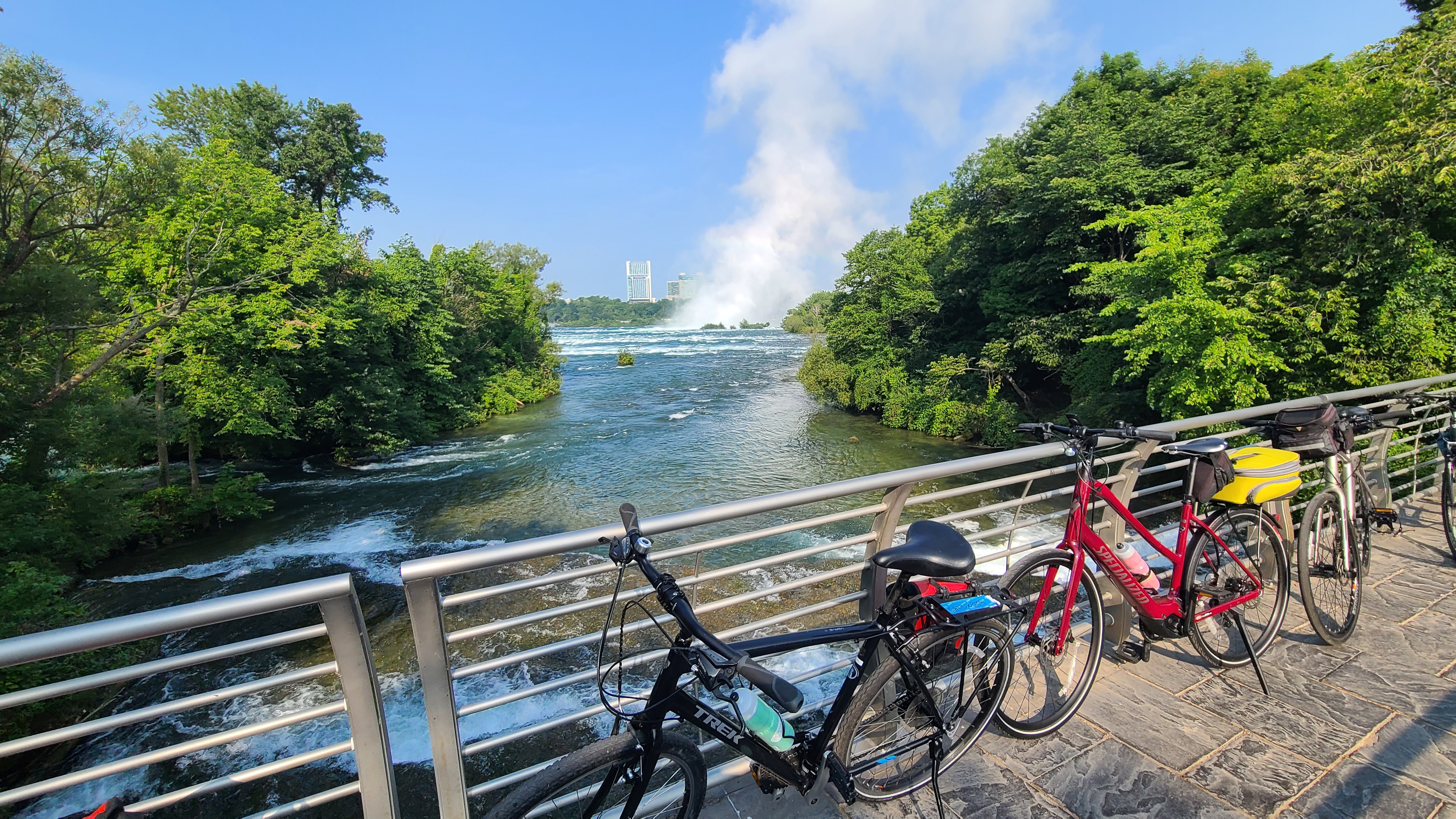
Mist from the falls

Canadian Falls

Maid of the Mist heading in

US falls in foreground, Canadian in background

Similar view in 1959 - I was 3!


Trail along Niagara River

Whirlpool

Lunch at the Lake

We pedaled back through Youngstown and stopped for ice cream.  Some War of 1812 action occurred here.


Really good frozen custard!

Dinner was on our own.  We went to Niagara Falls branch of Anchor Bar (of Buffalo).  These guys invented Buffalo Wings. We has some.  They were good.


Day two.  About 34 miles. Tonawanda to Medina (pronounced Med-eye-nah.  Really.)

They loaded the bikes up on the trailer and carted us out to Tonawanda to start riding the canal trail.  The first few miles were not promising.  The trail was mostly paved but bumpy and walled in from the canal by vegetation.  Not much to look at.  Lots of work picking your path along the trail.  Things got much better as we approached Lockport as the trail was fairly new, had a good views of the canals and was easy to ride. 

Lunch was on our own at Lockport and we spent some time view the locks and learning canal history.

1912 - current canal locks on the right.  1862 version of "flight of five" locks on the left

What an original circa 1825 canal boat looked like.

The original five locks were required to get canal up the Niagara Escarpment.  There were originally two sets. One set was replaced in the 1912 modernization (locks on the right)

Statues of 19th century lock keepers from a photograph.

Current canal is used by pleasure boats, primarily.

Here's the short history of the canal.  The original canal was four feet deep and forty feet wide and was so successful, it quickly became clogged with traffic and very hard to maintain.  By 1862, the canal was widened to 70 feet and made seven feet deep and remained a successful freight corridor..  By 1900, the canal was obsolete, having been eclipsed by the railroads.  But, in the early 20th century, the canal was completely rebuilt to accommodate large, motor propelled barges large enough to compete with railroads for freight.  It was now 120 feet wide and 12 feet deep.  This is the canal that exists today, although all the freight traffic dried up after 1960 as the St. Lawrence Seaway opened.  It's primary use is recreational boating.

The "tow path" the trail is on, is actually just the berm of the canal.

Typical canal path east of Lockport


1912 modernization included standard lift bridges over the canal.  Most still remain.


Lodgings in Medina


Day three  Medina to Rochester.  About 48 miles.

Some scenes of Medina.  A sizable town between Niagara Falls and Rochester.  


Medina is in apple country

Building at left is 1860's Opera House

At one point, the canal goes over a road.


Lift bridge in raised position


Arriving lunch spot Jane in the lead.  Me following.

Another lift bridge en route to Rochester

One the way to Rochester, after lunch, we stopped for ice cream in Spencerport. It was good that we stopped as it gave time for a thunderstorm to slide by us to the east without having to get out our raincoats.

Stopping for a look at where the canal crosses the Genesee River

Canal straight ahead.  River flows right to left.


Day Four - Rochester to Lake Ontario and back via Genesee River.  About 28 miles

Breakfast each day was a bit of an adventure.  The tour leaders seemed to favor greasy-spoon diners. No shortage of calories for pedaling!  (I worry about diners with "good food signs.  "Great food" is a bridge too far!)

Rochester from the Genesee River

Heading into the city

Stopping for a look at Interstate bridge

Group shot.  Show-off in tree.

Rose garden in park along route

Genesee River  still has lake boat service.  Cement being unloaded.

Beautiful causeway across a marsh on the Genesee


At Ontario Beach Park

View from the jetty

On the way back, a view of the Lower Falls on the Genesee

...and the Upper Falls in Rochester, proper

Downtown Rochester along the river


Group dinner was in old Lehigh Valley train station, now a Dinosaur Barbeque.

Art Deco do-dad on building

Day Five - Rochester to Palmyra.  A half day.  About 26 miles.

Leaving Rochester, the trail was paved and easy riding
Breakfast was in nice restaurant in Fairport.  Less than 10 miles from our start.  This is the view from the outdoor seating.  Old grain elevator on the canal converted to lofts.


Railfan platform and Conrail caboose in Fairport.  Worth a quick look!

The day ended with lunch in Palmyra.  Old canal and stone arch road bridge.

New locks at Palmyra

Restored standard canal bridge from 1860 canal modernization


Cast iron design was state of the art, then.


Then, it was back to Niagara Fall in the van. It was a really good trip.  Well run.  Good accommodations.  Would I do a Senior Cycling trip again?  Qualified "yes."  For contiguous trips where all lodging is right adjacent to the trail, you don't really need full time, on site leaders and support - just someone to tote your luggage and give you a ride back to start.  But, where there is ferrying to and from trail segments and lodging, these guys do a good job.  I can recommend!

The Erie Canal trail is generally a wonderful thing!  I really want to try another segment.  Maybe some day trips on the east end?  


Monday, August 19, 2024

The first 1000 miles - owning an EV

 We purchased and EV.  A Hyundai Ioniq 5. We've driven in about 1200 miles so far.  Here are some early thoughts.


Our EV


It's a car. It has four doors, seats, accelerator, brake, steering wheel, etc. etc.  Step on the brake and hit the start button and it turns on.  Shift into D and it goes.  It's a car!  But...

It's ridiculously quiet.  The loudest sound is road noise and it's pretty well insulated.

It's smooth.  There is zero vibration or harshness from a gasoline engine. It's noticeably absent.

It's smooth, fast, and lots of fun to drive.  We used to have an Audi Q5.  It was fun to drive. This is better.  In fact, I often say, "This is the car the Audi was trying to be."  Why?  Having the battery low and in the center of the car is ideal for handling.  Low center of gravity.  Low polar moment of inertia (weight not out past axles. closer to the center - why mid-engine sports cars are sought after).  This makes for quick and secure handling.  Power is super smooth.  No shifts.  Power is linear and  predictable.   No surprise downshifts or unwanted upshifts.  No lag.   Acceleration is mind-bending and all 300+ HP are available all the time at any speed, instantaneously.  I haven't floored it, yet.

You can do one-pedal driving - if you want to.  Or not. It's easy to set up for one or the other. How much regenerative braking is available when you back off the accelerator is variable using the "shifter" paddles on the steering wheel. One pedal driving means that letting your foot off the accelerator slows the car using regenerative braking.  You can make the smoothest of stops and starts using one pedal driving.  Most trips I don't touch the brake pedal at all, except in reverse.

It's a Hyundai, so the controls and displays are very similar to our Kia Telluride - part of the reason we chose it over other EVs - shallow learning curve and generally easy to use.  Kia is owned be Hyundai.

It has some EV weirdness.  Flush door handles that flip out when you approach with the key.  Regular old door handle would be better and the aerodynamic argument is dumb - it's a tiny, tiny advantage.  There is a lot less weirdness than in a Tesla, however.

It's range in local driving is much more than advertised.  The claim is 262 miles.  Actual range is 310-330 - and this with significant AC load - it's been hot! 

The regenerative braking often captures 50% of the energy spent on propulsion.  The more stop and go, the higher the percentage.   In the trip below, 14 kWhs were spent moving the car - 9 net with 5 recaptured in braking, so 5/14 or 35% was recovered on this trip.  Another two were spent keeping the car cool, the lights on and the 12 VDC battery charged.  A total of 11 kWh for 44 miles of driving is 4 miles per kWh - about 50 cents of electricity.

This was a trip to the airport and back.  Quite a bit of highway driving

It's sooooo cheap to run.  Cost per mile for energy so far is about 3 cents.  Put another way, it's like having gas at 90 cents per gallon. 

Charging at home is really simple.  But, you do have to have a home charger installed on a 240 volt circuit.  A clothes dryer circuit would be plenty and there are devices that allow you to switch between your clothes dryer and EV charging.  We had a ChargePoint charger installed and can charge at 11KW (240 volts, 48 amps).  Charging from 20% to 80% takes about 4 hours.  Plug it in in the evening and unplug in the AM.

An EV battery is not a gas tank.  You don't "fill-er-up" and drive to almost empty.  You just top it up after most days you do any driving at all.  It's a little bit better for the battery's overall life to keep the charge below 80%, so we rarely go above that.  If it's above 60% at the end of the day, I'll skip charging unless a there's a lot of driving to do the next day.  You start every day with "a full tank" without ever having to plan or make a trip to the gas station.

For what we sold our 1999 Expedition for, we purchased the home charger, had an electrician install it and had a Stealth Hitch 2" tow hitch installed for my bike rack. 

Old Ford on it's last day.

Doing a road trip requires quite a bit more planning... The winning solution requires that you plan to charge and take a rest break at the same location.  It looks like a 15 minute stop every 150 miles would do the trick - the Ioniq charges really quickly on the fastest DC chargers.  That's likely going to be a bit longer than trips in the Telluride, but not by much.  We haven't taken a trip that requires topping up at a fast DC charger yet.  There are quite a few trip planning tools out there - ABRP app for one (A Better Route Planner) - and I've planned a few hypotheticals.   I'll let you know about how that goes that in a future post. Full disclosure - we still own the Telly.  It has 3 row seating, hauls a lot and is best for road trips where we take the dog.  But, for all our day trips, it's the Ioniq that we go to.

So, that's the first 1200 miles.  So far, tons of fun!  

Sunday, August 4, 2024

Goodbye, Heat. Hello, Electric.

EVs are coming.  The only question how fast.

Really.

Want to know why?  

I can explain!  

The answer is efficiency.  I'm sure you've seen the memes.  An EV plugged into a coal fired power plant.


Haha! Might as well burn gasoline, right?  Wrong!  But, but....

Here's the deal.  Since the industrial revolution switched from water wheel power to steam engines, everything has been powered by "heat engines".  A piston steam engine, a steam turbine, a gasoline engine, jet engine, gas turbine, diesel engine... These are all heat engines.  

There's a thermodynamic/physics law that says the maximum efficiency of a heat engine is the Carnot efficiency: the ratio of the highest temperature and the lowest temperature involved in running the engine. (Carnot Efficiency = 1 - Tc/Th, c for cold h for hot)  Remember, the temperature scales start at absolute zero, which is -459 F. 

So, let's say we have a heat engine that uses 300 F steam and cools it to 60 F at exhaust.  1 - (60+459)/(300+459) = 32%.  This means if we could create a perfect heat engine that operates between these two temperatures, the most energy we can get out is only 32% of what we put in.  In practice, we are limited how close we can get to perfection by materials, the process we use (what engineers call "cycle") and losses like friction.

One more thing before we go on.  When we say "heat" we are really talking about something called enthalpy.  Think of it as a combo of temperature and pressure - a measure of how much energy the working substance has.  

We are limited on the high end by material science.  There are practical limitations on temperature and pressure using the materials at our disposal. We are limited on the bottom end by the low temperature of air, water, and land where we operate our heat engines. So, where does that leave us?

The nitty gritty.  Exactly how efficient are the heat engines we use?

A coal fired steam power plant?  40% thermal efficiency.

A gasoline engine running a car at steady highway speed? 20% thermal efficiency.

Half. That's all.  What? Why!?

That steam power plant runs at 1000 F, 3500 psi, and while a gasoline engine can approach this running at max RPM, wide open throttle, it's about half that for normal operation, so half the efficiency. 

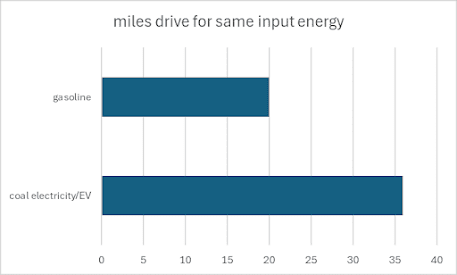
Some more math....  Let's compare energy use between a gas and a coal/electric car. For the coal/electric scenario, 100 units of energy go into the power plant.  40 come out to the wires.  10% of that 40 gets "lost" due to line resistance, so 36 get to the car.  Battery is nearly lossless charging and discharging, so 36 goes to power the car.

For the gasoline car, 100 go into the tank, 20 come out to move car. The rest goes to heat, internal friction, and auxiliaries like the oil pump and water pump.

So, for the same energy input,  the EV can go 80% farther.


Put another way, the input energy it takes to move an EV 36 miles, if electricity is from coal plant, will only moves a gasoline car 20 miles.

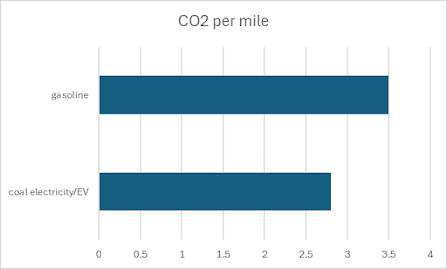
Now, let's talk CO2.  Coal has 40% more carbon than gasoline per unit of energy.  So, for the power plant, 100 of coal in gets me 100 CO2 out the stack.  Gasoline,  100 energy in gets me 70 CO2 out the tailpipe.  Plug and chug...

100 CO2/36 miles = 2.8 CO2/mile for coal/EV combo
70 CO2/20 miles = 3.5 CO2/mile for gasoline car.


My coal-fired EV goes 80% farther and emits 20% less carbon per mile!

Let's add in one more thing.  Regenerate braking.  I have some stats that show in suburban Atlanta driving, about half the energy it takes to propel the car is recoverable when braking.  That is, instead of burning off kinetic energy with brakes, an EV can use the motors as generators and put that energy back into the battery.

So, half the energy it takes to move me 36 miles is recovered when I stop, enough to move me another 18 miles.  Plug and chug...

54 miles vs. 20 miles. 


100 CO2/54 miles = 1.9/mi
70 Co2/20 miles =3.5/MI


270% farther with 46% less CO2/mi.

But, what about cost?  Okay. 

A typical EV goes 3 miles on a KW-HR of electricity. At home, that costs about 12 cents. That's 4 cents a mile.

A typical gasoline car gets 25 mpg.  At $3/gallon, that's $0.12/mile.

Over 20,000 miles, the EV saves you $1,600 per year in "fuel". But, EVs cost more to buy, right?  Yes, for similar sized SUVs, the EV costs $14k more,  After the $7500 US rebate, the net is about $7000, so simple payback is about 4 years.

But, if all of this is so, why didn't we have EVs decades ago?  The simple answer is technology.  There are two and two half big pieces I see.  

One is battery energy density.  Lithium Ion batteries are currently the top of the heap and have just enough energy density by size and weight to make a practical car.  It's only been a bit over a decade that practical batteries have been doable.  Note, that we are nowhere near the end of battery evolution.   It seem that about once a month there is news about battery chemistry advancement.

Two is high power solid state invertors that can turn battery DC voltage into variable frequency AC to power the motors.  These two pieces are the key.  We don't have these, we don't have EVs.  These were developed and matured in the 1990s and early 2000s and are in just about everything these days from phone chargers to locomotives. 

One "half piece" is rare earth magnets for the permanent magnet motors.  These make small, high torque, high power motors possible.  There are alternatives, but these really make things simpler and easier.  Rare earth magnets are pretty cheap these days-you even see them replacing pins and hasps in cheap jewelry.

The other "half piece" is computer power.  The complexity of EVs is in the computers and software that control the battery and propulsion. Fast, powerful computing makes them run well.  

There are many other factors that need to be considered to get the whole picture of EVs vs gasoline, but most of these, like mechanical simplicity, battery technology growth and longevity tilt in the favor of the EV and require a better treatment than just this post.

Energy is the big one.  EVs have won that game already.  The conversion will happen.  The only question is how fast.  The government is subsidizing the conversion speed to try to meet climate goals, but even without them, the conversion will occur.