Tuesday, January 31, 2012

Taxes - Not so hard, but never fun

It's tax time.  

Unless you are a hermit, you have to know. These guys, and others are everywhere.

If that isn't enough, anyone paying any attention to politics over the past few years has been inundated with sound bite after sound bite about income taxes, who pays how much, "The Buffet Rule", the Fair tax, fair share, flat taxes, marginal rates, effective rates, etc. etc.

Just about everyone is confused.  Why?  The tax code is over 70,000 pages long?  Who can know all of it?

Fortunately, though, the fundamentals are pretty simple... 

although most people are thoroughly confused.  It think its the size and complexity of all those tax forms that do it.  Every one of those 70,000 pages makes itself felt somewhere on one of those forms.  But the basic "drive train" of the income tax system is not too complicated.  You don't need to know how to work the climate control or On-Star in order know how to start the engine and drive. You don't need an accounting degree or even high school math.  Regular old 4th grade math should do it.

It's called a progressive income tax.  

Progressive means that for each additional dollar you earn, you owe a greater percentage of that dollar in tax. It's been this way since Woodrow Wilson needed to pay for WW I.

For a single person, this is how it progresses.


income from to is taxed at
 $                        -    $               8,500 10%
 $                 8,500  $             34,500 15%
 $               34,500  $             83,600 25%
 $               83,600  $          174,400 28%
 $            174,400  $          379,150 33%
 $            379,150  ....and up  35%


You pay 10% for the first $8500 you earn.  So, if you make exactly $8500, you pay $850 in tax.

Now, for the tricky part.

Then on the next dollar you earn, you pay 15% or an additional $0.15.  So, if you make $8501 you pay $850 plus $0.15 = $850.15.  If you made $8502, you'd pay $850.30 in taxes.

And so on.....

Each step in the table is commonly referred to as a "tax bracket".  If you make $50,000, you are in the 25% tax bracket.

A common misconception is that your tax is: your income X your tax bracket rate.   WRONG. That would be a variable rate flat tax.  Our income tax is progressive.

For married people filing a joint tax return the tax brackets are:


income from   to  is taxed at
 $                            -    $                 17,000 10%
 $                        17,000  $                 69,000 15%
 $                        69,000  $               139,350 25%
 $                     139,350  $               212,300 28%
 $                      212,300  $               379,150 33%
 $                      379,150  ....and up  35%


That's it. That's our progressive income tax.


But wait, there's more....how about some exemptions?

People have to eat and have a place to live and they can have kids that eat and require shelter as well.  In order to give people a break, the tax code allows a certain amount of income to be exempted from taxation.

For each person in your household, you get a $3400 exemption.  For a family of four, that adds up to $13,600.   That means you get to subtract that amount from your income before you figure your taxes.

For a family of four with an income of $70,000, they get to adjust their income down to $56,400 using their exemptions.

And, even more....how about some deductions?

The government also wants to help you own your own house and they want you go give to charity because these things improve our society, so they allow you to deduct mortgage interest and charitable donations from your income, too.

They also allow deductions for other necessary and/or desirable things such as work expenses, heath care, education, child care, etc.... within certain limits.

But, even if you don't pay a mortgage or give to charity or pay for your own health care, you still get to make a deduction.  It's called the standard deduction.  For a married couple, it's $11,900.

So, that family of four with the $70,000 income only owes tax on 70,000 gross income - 13,600 exemption - 11,900 dedcution = $44,500.  This family is in the 15% tax bracket and their effective tax rate is 8.3% (gross income of $70,000 and tax of $5825 give an effective tax rate of 8.3%, just divide!)

Here's the breakdown in table form:


Example: family of four
income  
Dad  $                      35,000
Mom  $                      35,000
Kid 1  $                                -  
Kid 2  $                                -  
 exemptions   
Dad  $                     (3,400)
Mom  $                     (3,400)
Kid 1  $                     (3,400)
Kid 2  $                     (3,400)
 standard deduction   
   $              (11,900)
 adjusted income   
   $                 44,500
tax calculation
from to is taxed at tax owed
 $                                   -    $                      17,000 10%  $         1,700
 $                        17,000  $                      69,000 15%  $         4,125
 $                        69,000  $                   139,350 25%  $                -  
 $                      139,350  $                   212,300 28%  $                -  
 $                      212,300  $                   379,150 33%  $                -  
 $                      379,150  ...and up  35%  $                -  
total  $        5,825
effective tax rate 8.3%


Another example.  Married couple, no kids, each earns $80,000.  (Chances are these guys will itemize their deductions because their mortgage interest and charitable giving will add up to more than $11,900, but I'll leave it at $11,900 for the example)

These guys are in the 28% bracket and have an effective rate of 17.3%


income  
Dad  $                      80,000
Mom  $                      80,000
Kid 1  $                                -  
Kid 2  $                                -  
 exemptions   
Dad  $                     (3,400)
Mom  $                     (3,400)
Kid 1
Kid 2
 standard deduction   
   $              (11,900)
 adjusted income   
   $               141,300
tax calculation
from to marginal tax rate tax owed
 $                                   -    $                      17,000 10%  $         1,700
 $                        17,000  $                      69,000 15%  $         7,800
 $                        69,000  $                   139,350 25%  $       17,588
 $                      139,350  $                   212,300 28%  $             546
 $                      212,300  $                   379,150 33%  $                -  
 $                      379,150  ...and up  35%  $                -  
total  $      27,634
effective tax rate 17.3%


Capital Gains are different - sometimes

So, what's all this noise about the "Buffet Rule" and Mitt Romney only paying 15% effective tax rate?

It's something called long term capital gains.  They get taxed at a lower rate.  Why?  The presumption is that you want people investing in the stock market for the long haul, not just buying low at 9AM and selling high at 3PM.  It's good for the economy to get people investing long term, so, the government gives you an incentive to do it.  So, there is a different, lower rate for long term capital gains.

An example.  You buy one share of Ford stock at $12 today and hold it for 10 years, selling it at $22 dollars.  You have a capital gain of $10 ($22-$12), and owe the long term capital gain rate of 15% or $1.50 in tax on it.  If you didn't hold it "long term" you would just have to count the gain as part of your regular income.

Here's some history on this.  

It's actually a bit surprising who did what, when.

Since pretty near the beginning of the income tax, there has been a different tax rate for long term capital gains.  Sometimes it varied, getting lower the longer you held the investment. Sometimes, it was all at a flat rate.

The biggest change in recent history occurred during the Reagan administration in 1986 when the tax code was greatly simplified.  They did away with any differentiation for capital gains income.  Capital gains of any kind were taxed as regular income.  When this was true, guys like Buffet and Romney would have paid nearly 28% in taxes, the top tax rate at that time.

This was Reagan's idea. Surprised?  There was a trade-off.  The tax brackets were flattened and their number reduced at the same time, so the uber-wealthy had their regular income taxed less heavily.  But, Reagan and a Democratically controlled House agreed to an implemented these changes.

So, how'd we get here?

1997.  Bill Clinton.

Surprise, again!

He lowered the tax rates on long term capital gains to 20%. George W. Bush cut them further to 15%.

So, a guy like Buffet who gets all his income from long term capital gains, pays about 15% in tax while his secretary, who presumably is decently paid and in the 25% tax bracket, probably pays closer to 20% effective tax rate.

What next?


I have no idea.  Should long term capital gains be taxed lower than ordinary income?  Does the incentive help the economy? Who knows?  Nobody is even talking about it.  All the heat is on tax brackets.

President Obama has proposed raising the rate on the top bracket and/or creating a new, top bracket.  Neither he nor anyone else has even whispered about changing the tax rate for long term capital gains.

Maybe the way out is to do another round of tax simplification ala 1986 and whittle the tax code back down to 20,000 pages or so.

Maybe just cap long term capital gains income at no more than ordinary income.  You make $1,000,000 at your day job and $5,000,000 in long term capital gains, you pay the regular tax rate on $4,000,000 of your capital gains.

Maybe, just let all of the Bush tax cuts expire.  Though both Republicans and Democrats are against this, they don't seem to be able to agree on alternative.

Maybe replace the income tax with a consumption tax.  Buffet buys a yacht, he pays 30% sales tax.  Of course, that means no more dancing statue of liberties gracing the street corners every winter - although they'd probably be replaced with some other no-value-added life form.

There are a lot of ways to skin this cat.  They all better get moving and pick one!


Tuesday, November 8, 2011

Germany!


The Trip Begins

"The Oliver Wyman Rail Planning Conference is in Hamburg, Germany.  Do you want to attend?"  That's what the email from our department head said.

Stupid question.

Of course I want to attend!  And, I want to take a few vacations days, get Patti out of work for a week, find cheap airfare and figure out what else to do while I'm there.  Duh!

Patti hit the library and I hit the internet.  Between the two of us, we figured out that we could get a good, cheap, direct flight in to Frankfurt, spend a few days on the the best part of the Rhine and get up to Hamburg without spending all day getting there.

So, that's what we did. Here's how it went.


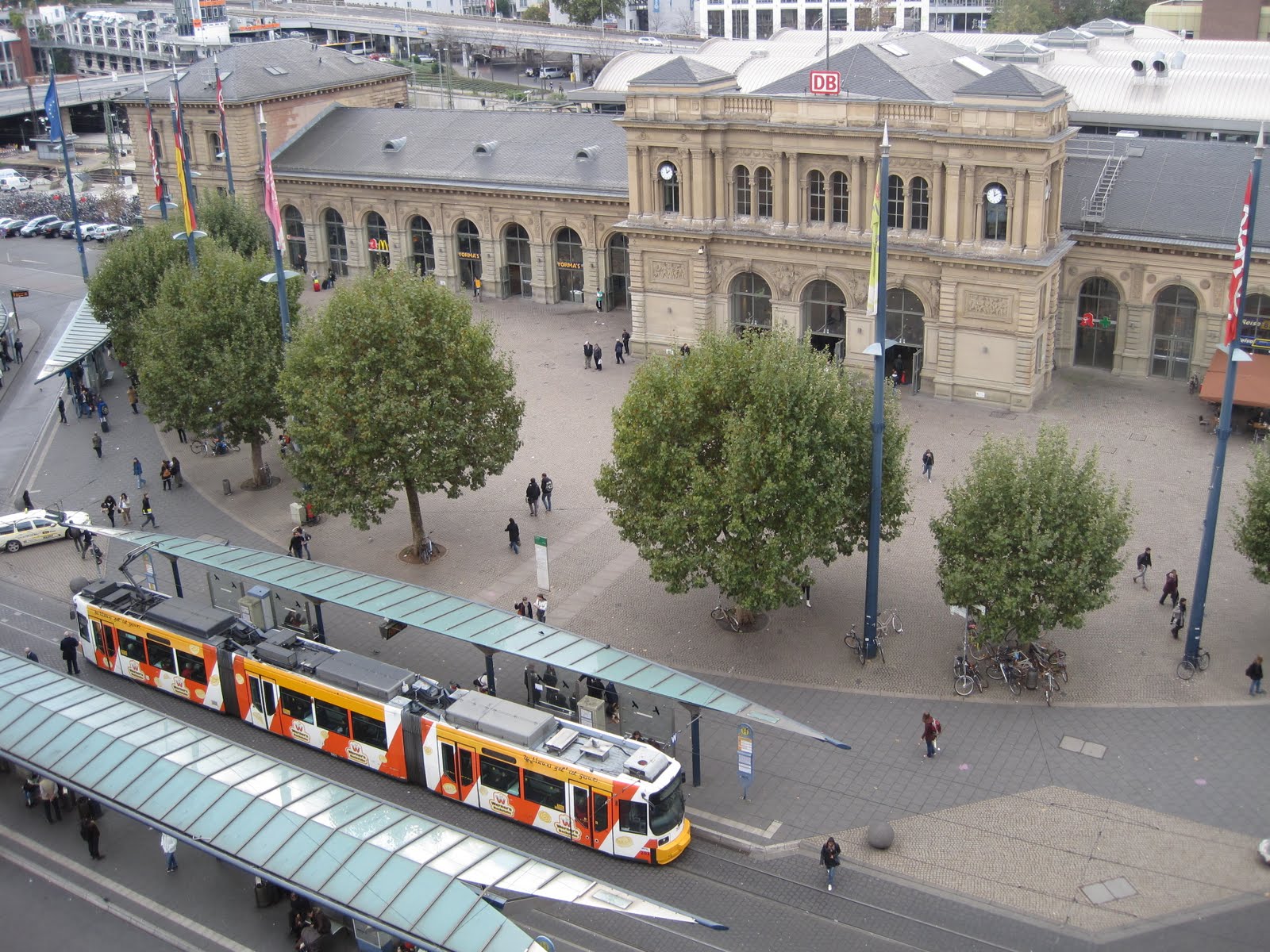
Mainz Hauptbahnhof

We flew out of Atlanta on Wednesday evening on Lufthansa.  Airbus 340.  Nice plane.  Nice airline.  Nice crew.  We would fly Lufthansa again.  Plane was only part full, so Patti and I each took a window/aisle seat pair and stretched out a bit.  I actually managed to get a few hours sleep.

We arrived at Frankfurt airport and after much meandering and waiting in line, we claimed our bags, cleared passport control and headed for the train station at the airport.  The airport itself is a dump.  Reminds me of the NY Port Authority bus terminal in it's mid-70s incarnation. - but, who vacations at the airport!

After a considerable hike, we found the train station, got our rail pass activated and headed for the platform.  Frankfurt's airport is only about 20 miles from Mainz, where we would be staying and our rail pass was good on all train types, so it wasn't long before a train headed our way showed up.

Travelling by Train in Germany

Traveling by rail in Germany is really easy - and cheap if you buy a German Rail Pass before you arrive.  We bought a 4 day pass, but goofed and could have gotten a 6 day pass for the same price - a special deal for North Americans that I missed when perusing the DB Bahn (German Passenger Railroad -the German version of Amtrak) website.  The 4 day pass was good on for any four days within a month.  It was good on all DB Bahn trains as well as the KD Line Rhine tour boats.

The German rail network is well integrated.  There are four basic types of trains on the network.  ICE (Intercity Express) trains are the top dog.  If you are familiar with Amtrak, these are their Acela or Metroliner trains.  They go fast (up to 125 mph) and really fast (up to 187 mph) depending on whether they are on the new, high speed right of way or on regular track.  
ICE train at Mainz
Next, are the IC (Intercity) trains.  These go fast and generally stay off the new high speed tracks.  They make more stops than the ICE trains, but cover more routes.   These are equivalent to regular Amtrak corridor trains.  
IC train interior
IC train at Hamburg
Next are the RE (regional trains) and finally the S-bahn trains.  These are more like commuter rail trains in the US.  They operate like spokes out of the major city hubs.  The RE trains generally have longer routes and make fewer stops than the S-bahn trains. The best US example I can think of is a NJT local to Jersey Ave would be like an S-bahn train and a rush hour Trenton Express would be like an RE train.

RE train at Boppard


S-bahn train in Frankfurt
Mainz and the Rhine


Our hotel was right on the train station plaza, but we were there too early to check in.  So, we checked our bags at the hotel and they gave us a map and some suggestions for walking about the city.  We toured the city and had lunch - totally making a mess of German restaurant etiquette.  In Germany, you typically seat yourself, ask for you check, leave a smallish tip, and don't leave the tip on the table.  We got one of four right.  Then went back and checked into our hotel.
Schiller Platz, named for the poet
Funky fountain
Caldor stained glass window
Residential street
Altstadt - Old City
Original half-timbered buildings
Old, narrow, winding streets
Catholic Cathederal
Marktplatz
Gutenburg Museum - maybe next time we'll go inside!
The view from our hotel room
Our hotel was an older building that was pretty thoroughly modernized.  Our room was on the top floor that was added on the roof of the original structure.  The elevator only went to floor 5.  We had to walk up a flight to get to our room on floor 6.  Funky euro-modern purple decor.  King bed with two twin comforters with covers.  No top sheet

Walking around Mainz we got a good taste of what living in Germany was like.  The city streets were lined with shops of all kinds.  There were small department stores and mall-type boutiques clustered into shopping areas.  There were small supermarkets without parking lots as well.  Nearly all travel to and from the shops was by foot and transit and the city was buzzing most hours of the day.

"City Bakery" in Hamburg
 Bakeries abound in Germany.  There is one on every corner and a two in between.  There are few overweight Germans despite the massive carb loading that must take place.  Maybe all the hoopla about carbs and dieting is nonsense?  Maybe, all you have to do is walk everywhere and you can eat what you like?  We did and we did!

Mainz is a college town. At night, the locals like to hit the biergartens scattered around the station plaza.  Then, they like to go outside and sing...and throw bottles.  Not quite like listening to crickets chirp.

On Friday, we got up early.  Okay, we tried really hard to sleep in, but still got up really early.  I guess it takes more than a day to adjust to the time change.  We headed over to the train station and took the MittelrheinBahn train up to Bingen to catch the KD boat that would take us to Koblenz.
MittelrheinBahn train at Mainz.  These zippy, new electric MU train sets got close to 100 mph in spots.
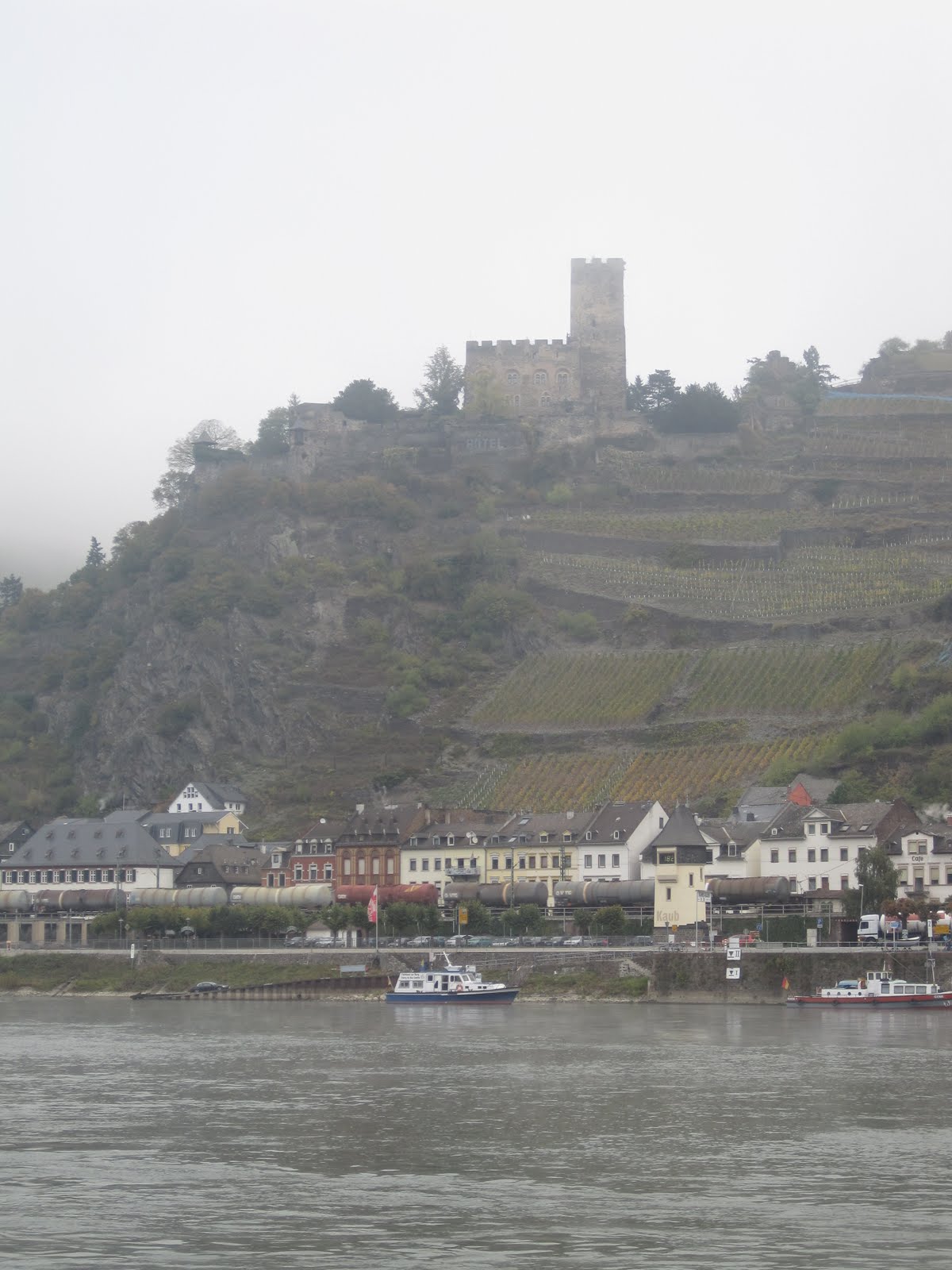
The forecast was for a sunny day.  It wasn't.  It was foggy.  Pea soup thick when we started, but it lifted a bit and we could see most everything along the river.  The boat stopped at about a dozen towns on both sides of the river on it's 40 mile journey.  Lots of picturesque towns with castles and castle ruins scattered on the hilltops above the towns.  Most got built so the castle owners could stop river traffic and "collect" a toll.  Great business model.

Many were repeatedly attacked over the years and were in ruins in by the 19th century.  When the Prussians governed the area in the 19th century, they restored quite a few in the interest of history and heritage.


Once at Koblenz, the sun finally came out.  We had lunch at a cafe on a plaza in the middle of town, then walked about.
Plaza in Koblenz
We went to Deutsches Eck (German Corner - literally) where the Mosel joins the Rhein.  There was/is a monument to German nationalism there - Kaiser Wilhelm sitting on his horse.  It was destroyed down during the bombing in WWII but wast replaced in the1990s.
The corner

Wilhelm on his horse
Then we hopped on the train and headed for on of the nice towns we spied from the boat: Boppard.  It was one of the larger towns on the route, but it was still convenient to walk from the station into the town and look around.  There were nice views of the river from the waterfront.  There was also a chair lift to an overlook, but that had stopped running by the time we arrived.

MittlerheinBahn train departing Boppard

Typical river traffic on the Rhein

Boppard

Typical street in Boppard.  Not much traffic.

Cafe where we stopped for a drink and a snack.  Owner fed us with lots of information about  the town as well as cherry cobbler.

Diesel rail car at Boppard - headed up a scenic branch.  Have to save something to do for the next trip!
We headed back toward Mainz at dusk.


Saturday, we headed out to hit some of the other interesting towns we had seen from the boat the previous day.  First stop: Sankt Goar.  Due to maintenance work, we the train was "bustituted" north of Oberwesel.  No problem. The buses were there to meet the train at Oberwesel and take us on to St.Goar.

St. Goar has one of the best castle ruins on the Middle Rhein - Burg Rheinfels.  Part of it was converted into a  hotel, but most of it is ruins you can tour for a fee.  The inner part still has it's medieval walls in place and you can see how it was built up over the years as it's use and armament technology changed.
Burg Rheinfels

Original Medieval wall


Looking downstream toward the next castle

Defensive corridor on a "newer" addition

The castle also afforded a great view up and down the river.
Looking downstream

Detouring IC train passing through Sankt Goarhausen
The Germans are serious gardeners.  We saw this two places.  One was the graveyards were treated as garden plots with lots of stuff blooming.

Graveyard in St. Goar

The other was the ubiquitous Schrebergartens.  Small plots of land sudivided out of larger parcels where Germans can go to grow stuff.  They typically are located along the railways just outside of the cities.

Schrebergatens represented on Minatur Wonderland model railroad in Hamburg
We hopped back on the bus and headed south to Oberwesel.  This town has a good chunk of it's original town wall still in place and a bunch of towers along it.

Oberwesel town wall and towers

Town gate in wall
Then, back on the train and down to Bacharach.

Bacharach has a wine festival each year, but it is in the Spring

Typical castle overlooking the town

Typical narrow street with half timbered buildings

The center of town

Flowers, half timbered buildings and vineyards

Downtown Bacharach

A side street

The big church in town

Church ruin created when attackers leveled the castle on the hill.  Chunks landed on the church.

City gate
We typically were trying to eat at the wrong time of day.  Most places stopped serving food in the early afternoon and then didn't start back up until dinner at 6PM or later.  We were always looking for a late lunch...with out luck.

So, we left Bacharach for Bingen.


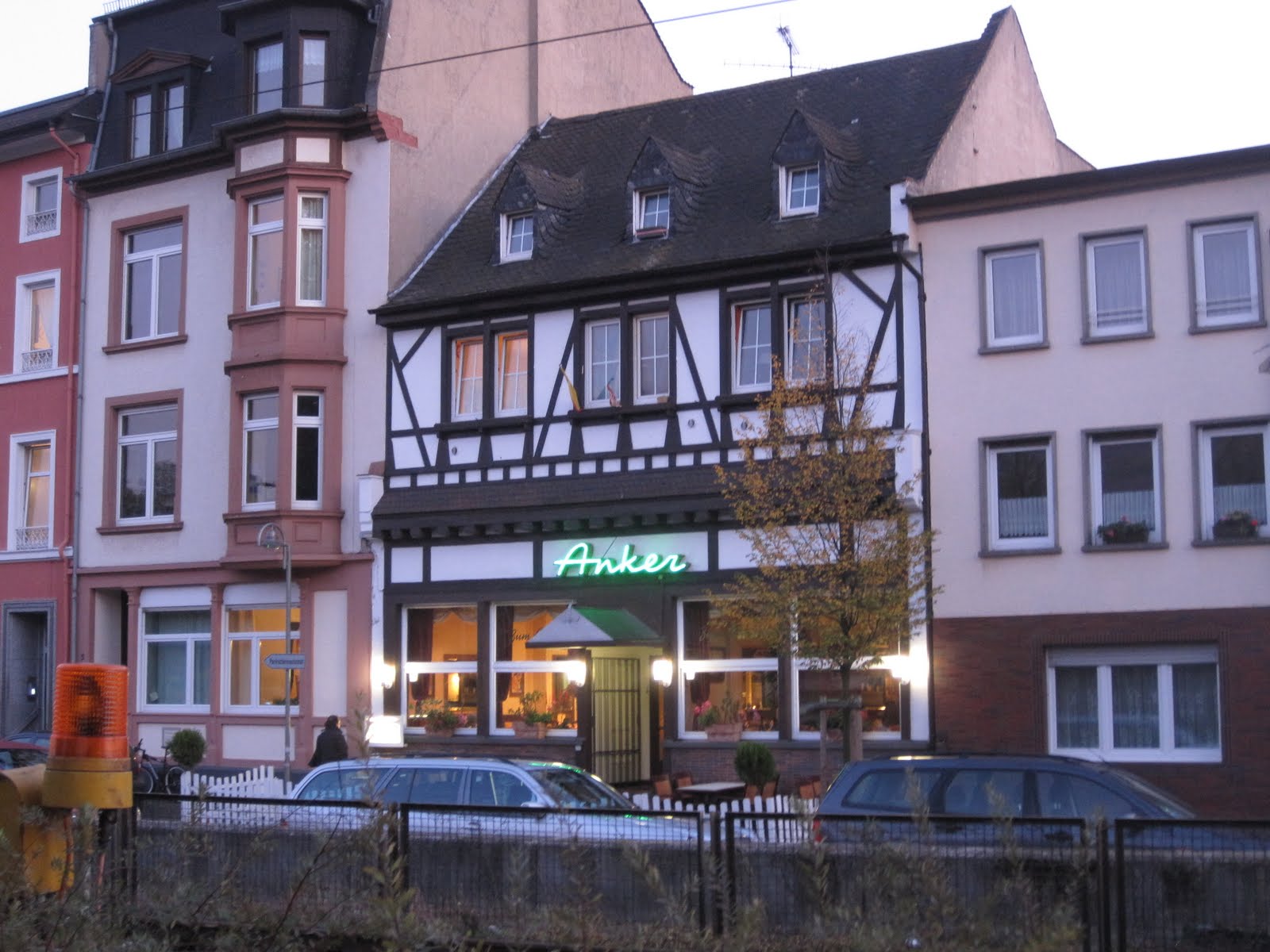
Dinner place
We found a place open for dinner at 5PM.  Good deal!  Except we didn't speak German and the server didn't speak English.  We wound up with Wiener Schnitzel (fried pork cutlet) and French fries.  Oh, and some Riesling wine!  It was all good!

That pretty much did it for our trip along the Rhein.  We took the train back at dusk and called it a day.  

On to Hamburg

Sunday it was off to Hamburg on the ICE train.

ICE train to Frankfurt

Scene inside Frankfurt's large train shed

Frankfurt Hauptbahnhof

We boarded an ICE train in Mainz and took it Frankfurt where we change for an older model ICE train to Hamburg.  The train was packed!  All 12 cars! And, full of people's luggage!  After boarding the train, we had to struggle through a couple of cars, dragging our luggage before we found two adjacent seats.  The train wound its way east until it passed under the dedicated high speed line coming up from the south.  The tracks made a big, looping climb to join that route and then it was off to the races!  The train quickly speed up to 150 mph and plunged through tunnels and then over viaducts, straight as an arrow, headed for Fulda.  Each valley was covered in farm land and had a small village in it.

View from viaduct on at 150 mph
After Fulda, the train stopped at Kassel and then Hannover.  About half the train got off there and we found and empty compartment and moved in for the last leg to Hamburg.

After arriving at Hamburg, inside the train shed

We grabbed some lunch at a bagel shop in the train station and hoofed it over to the hotel, a few blocks away.  After checking in, we got a map along with suggestions for a walking tour of the city.

Rathaus - City Hall

St Nikolai - a ruin kept as a monument

A street in the old part of town

Speicherstadt - Warehouse District

St. Michaelis

The view from St. Michaelis

Upper and Lower Alster Lake
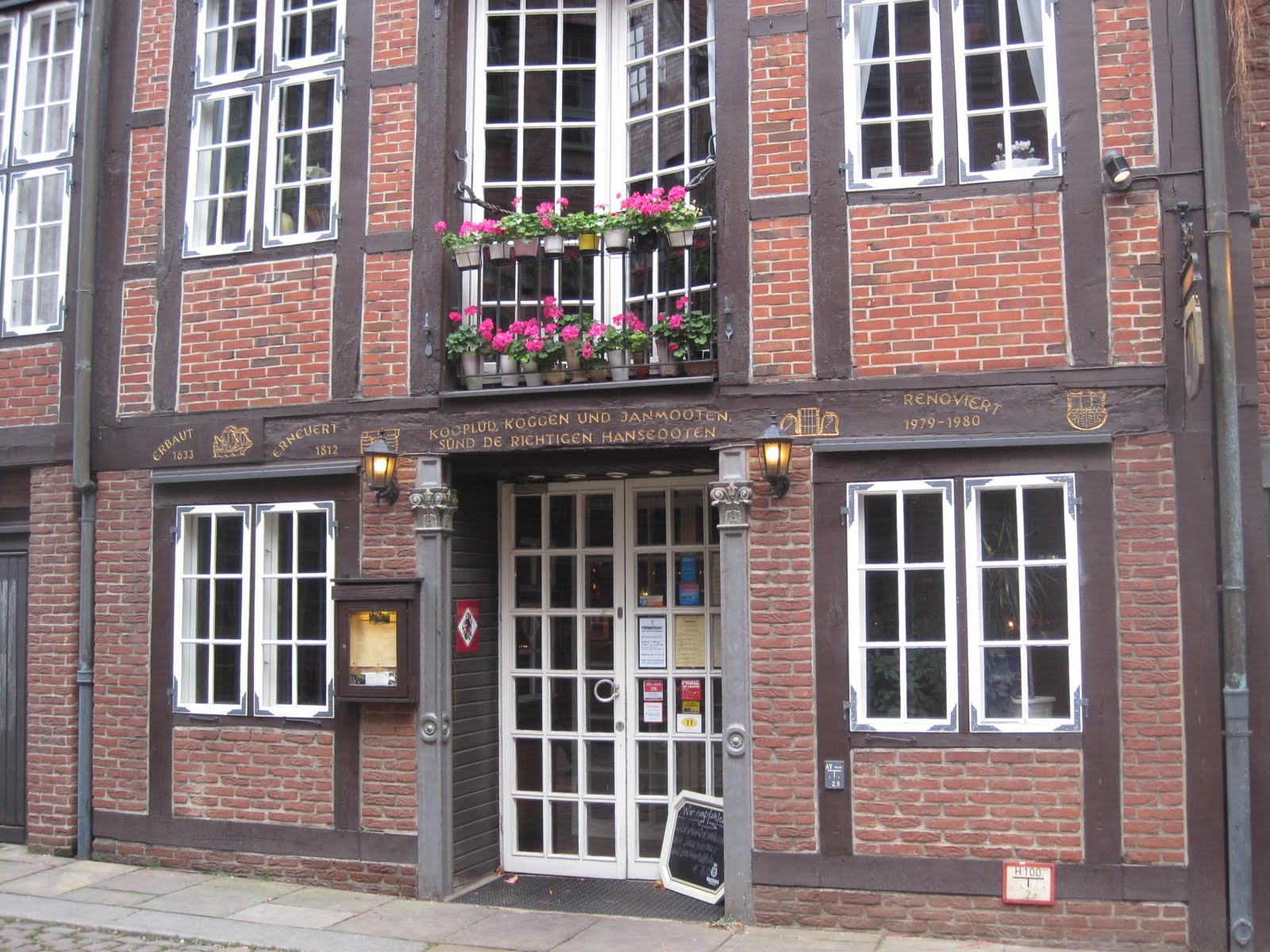
We ate at the place the concierge recommened - "The Olde Commercial Room".  English name. All German inside.  Once again, the language kept us from knowing exactly what we ordered, but we had Riesling down pretty good by this point.  Once again, good food!  Patti had some meatballs in white gravy and I had currywurst.   Currywurst is actually a very popular fast food in Germany.  It's basically a sausage with some amped-up ketchup on it.  Very tasty, but not particularly health food....

During dinner, a couple of mid-30s guys were seated at the other end of the table.  They had just come from watching the local soccer team - St.Pauli - and evidently had been enjoying the beer as much as the game.  We had an interesting almost-conversation discussing football/soccer, basketball and politics.  Interestingly, they knew Dikembe Mutombo, but not Dirk Nowitzki (who is the best and most famous German player in the NBA)  and Dick Nixon and Ronald Reagan but not George Bush and Bill Clinton.

After dinner, we headed back to the Speicherstadt to visit  Miniatur Wonderland, the worlds largest Model Railroad. We rushed through in 2 - 1/2 hours.
Station scene in Switzerland

Switzerland

Airport where planes taxi, takeoff and land.


Airport parking

Palace

Carnival

Las Vegas

South Beach nightclub fire where alarms sound and firetrucks arrive one at at time

Scale model of Hamburg Hauptbahnhof

Beach with actual tides

Scandinavian port

Winter train station scene in Finland
Monday was a gray and windy day.  We took a circle bus tour around the city and then a harbor tour by boat.  The tickets we purchased, like all tickets were joyfully stamped by a mechanical time stamp.  The Germans seem to like stamping things.  Train tickets are stamped.  Tour tickets are stamped.  Everything. Kachunk, kachunk, kachunk!

Port building

Ferry trip, just before the crash.

Container ship in port
The harbor tour took through all parts of the port.  The old warehouse district, the new mixed used development nearby, the working container port and the shipyard area.  The tour was given in German and then English. As we were cruising through the old warehouse area, the boat lost power and crashed into a warehouse, collapsing the radar mount on the bow. At that point, all "narration" became German only!  The send a rescue boat, we all transferred and the tour continued.

After the tour, we once again hunted around for a good lunch spot eventually settling for some fast food - currywurst and wine.  No longer hungry, we walked about the city and wound our way back to the hotel.
Trostebrucke - "Comfort Bridge"
The entrance to Speicherstadt

Archbishop Ansgar - founder of first cathederal in Hamburg in 9th century

Count Adolph III - founded secular portion of Hamburg in 13th century


Old residential street in Altstadt (old city)


Old building along the canal leading to the Alster lakes

Lemon Jette - rub her finger for luck!

Old alley

History of the old alley

St. Peters church - typical gothic church tower

That evening, the conference started.  Tuesday was a full day of sessions followed by dinner out.  Wednesday's presentations were followed by a visit to the local Duetches Bahn hump yard in Maschen.
Double slip switch in engine terminal area

Engine Terminal ready tracks

Our group

8000 HP freight locomotive headed for servicing

Hump tower

Bypassing the hump

While I was doing this, Patti was out scouting the city.  She walked around Upper Alster Lake (5 miles) and also checked out the local area around the hotel and train station.
Bridge with locks on Alter Lake
Day trip to Hannover

With the Thursday AM portion of the conference cancelled, we had a whole day to go and explore.  Rummaging through a tour book, we decided on Hannover, about 115 miles to the south.  Our German rail pass was all used up, so we purchased round trip tickets and seat reservations from the vending machine in the train station.  We got an early start, hitting a local bakery for breakfast and rode the intercity train to Hannover. 

At the station

Uh, oh!  Another foggy day?  No.  Just some patchy fog in the countryside
 On arrival, we hit the tourist info center and booked a bus tour.  The tour was very good.  We were the only English-speakers on the tour, so we got a bit shortchanged on the narration, but the guide was excellent, in general.

Site of former summer palace

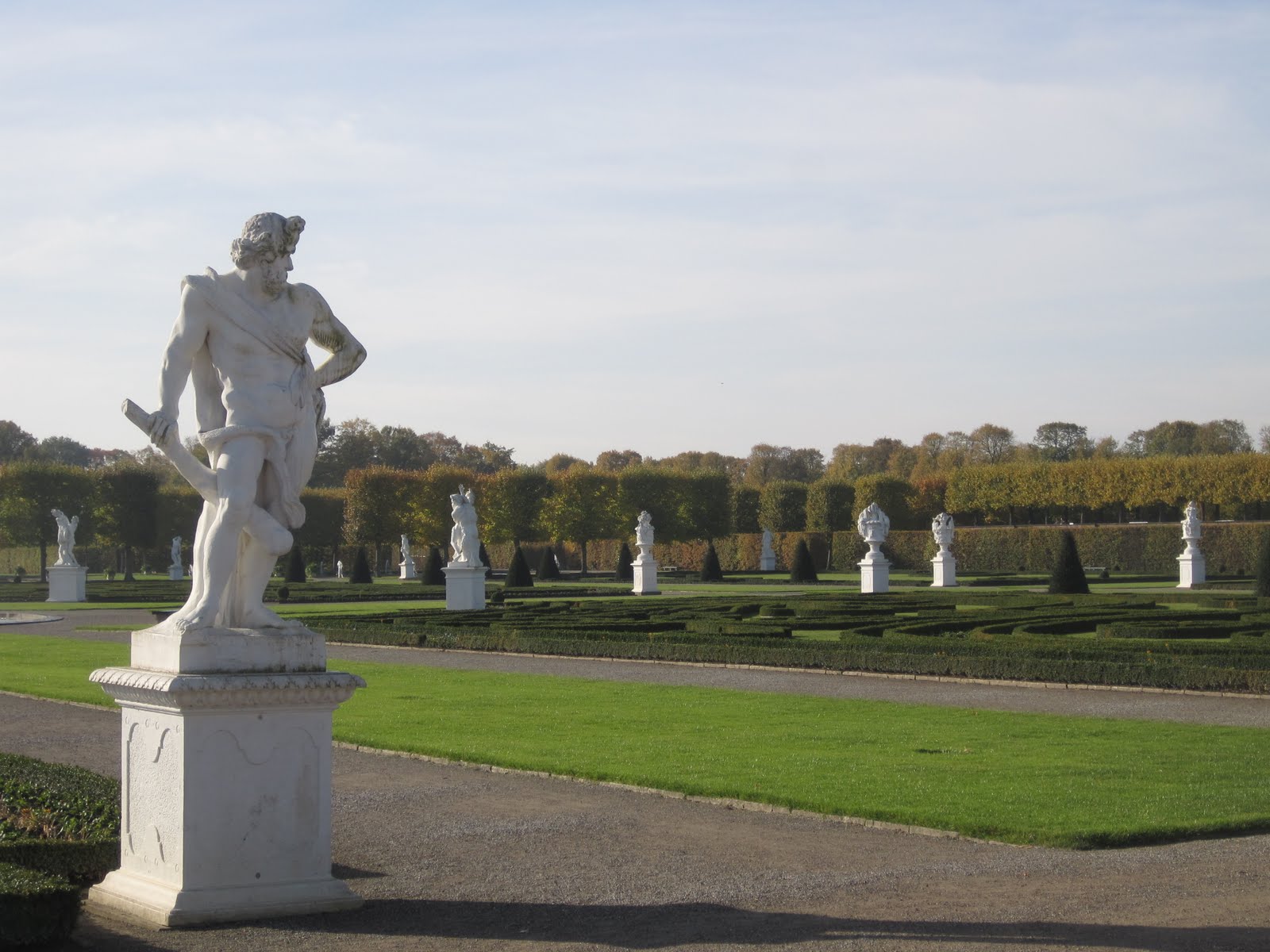
Formal gardens

Grotto.  Rebuilt by a local artist.  To be part of rebuilt palace/convention center.

More gotto art.

Red Brick Gothic - old city hall

Martin Luther is everywhere!


Church ruin as memorial

The three ladies, plus Patti.
The locals hated these when they first went in 30 years ago, but now the art and artist are local celebrities.

Hannover's river - Liene

Surviving half-timbered building facades were gathered after WWII and reassembled in one area.

Philadelphia has the Wanamaker's Eagle.  Hannover has the stallion's tail.  It's where you meet.
King Ernst-August, the last of the British - Hanovarian Kings prior to Prussian annexation, on his horse outside the train station.

Typical shopping street in Hannover.
That was it.  The next day, sadly, we headed home.

Some miscellany

Bier!

Lots of beer in Germany - as you might have guessed.
Bier!
Most of it is better than most US beer.  Even the national, mass produced beers like Bitberger are better than their US counterparts (Miller, Budweiser, Coors, etc.).

"So..."

So, why do all the German tour guides start every sentence with "So,"?  I don't know.  But, since it is the same word in German as English, I know it wasn't just poor translation.


Bernd das Brot

A depressed loaf of bread puppet that has his own TV show.  I had almost no idea what was going on in the show, but I found it mesmerizing.  His usual commentary on the things happening in his world are "Mist", which is roughly translated as "crap" and "Mein leben ist die Holle", "My live is hell."

Bernd das Brot article

YouTube clip of Bernd with subtitles


Open bottle of wine

So, you are are out shopping and you think it would be a good idea to grab a bottle of wine to bring back to the hotel.  It's cheaper to buy a whole bottle at a convenience store than to buy a glass or two at the hotel.  But, you don't have corkscrew.  What do you do?  You ask at the store if they have a one, hoping to buy a cheap one...and the guy will pop the cork for you!

Pedometer

We have a program at work where they will pay you to exercise.  If you can do 7000 steps a day - about 3-1/2 to 4 miles, on the average, you can earn about $200 a year.  For me, that works out to my normal activity plus a dog walk a day.  All I have to do is wear a pedometer and download it to my computer.  I took it to Germany with me.

Our days wandering around Germany racked up a whole mess of steps - typically 17,000 - 19,000 a day with one day at 23,000.

That's a lot of kilometers!  (Good thing I had new sneakers)

Quiet Night Campaign

Mainz is a college town, among other things.  It is also quite near the Frankfurt airport - about 10 miles out.  These two things would seem unrelated, but they are, by irony.

The air traffic at Frankfurt is increasing and the locals in Mainz apparently don't appreciate in increase in noise, especially at night.  So, they have started a "Stille Nacht" campaign, trying to get the airport to shut down in the dead of night.  There was a big rally at the train station in Mainz when we were there.

The normal overnight activity in Mainz involves college students crowding into the local Biergartens and drinking until the wee hours.  Then the hit the streets gabbing, singing and throwing bottles in the air.  All of it quite loud.

I guess the definition of "quiet" depends on what you consider noise!

Occupy Hamburg

Yup.  Same deal going on in Germany, too.  Urban Campers with poorly made cardboard ambiguous signs in a small tent city in the back of a small park.  (Sorry, no pictures)

Trying to speak German...not so much


One year of German in high school doesn't leave much residue 38 years later.  "Guten Tag", "Ich spreche kein Deutsch", "Danke schon", some numbers and a few random nouns and verbs and a foggy notion about verb conjugation are about it.  Good thing most younger Germans speak terrific English. Still, I attempted the occasional greeting in German.  "Guten Morgen", I'd say, only to receive a stream of unintelligible (to me) German.  So, mostly we stuck to the unmistakably American, "Hi!"  Next time I'm going to try Rosetta Stone before we go.  I want to a least be able to order some currywurst in German.