Monday, August 19, 2024

The first 1000 miles - owning an EV

 We purchased and EV.  A Hyundai Ioniq 5. We've driven in about 1200 miles so far.  Here are some early thoughts.


Our EV


It's a car. It has four doors, seats, accelerator, brake, steering wheel, etc. etc.  Step on the brake and hit the start button and it turns on.  Shift into D and it goes.  It's a car!  But...

It's ridiculously quiet.  The loudest sound is road noise and it's pretty well insulated.

It's smooth.  There is zero vibration or harshness from a gasoline engine. It's noticeably absent.

It's smooth, fast, and lots of fun to drive.  We used to have an Audi Q5.  It was fun to drive. This is better.  In fact, I often say, "This is the car the Audi was trying to be."  Why?  Having the battery low and in the center of the car is ideal for handling.  Low center of gravity.  Low polar moment of inertia (weight not out past axles. closer to the center - why mid-engine sports cars are sought after).  This makes for quick and secure handling.  Power is super smooth.  No shifts.  Power is linear and  predictable.   No surprise downshifts or unwanted upshifts.  No lag.   Acceleration is mind-bending and all 300+ HP are available all the time at any speed, instantaneously.  I haven't floored it, yet.

You can do one-pedal driving - if you want to.  Or not. It's easy to set up for one or the other. How much regenerative braking is available when you back off the accelerator is variable using the "shifter" paddles on the steering wheel. One pedal driving means that letting your foot off the accelerator slows the car using regenerative braking.  You can make the smoothest of stops and starts using one pedal driving.  Most trips I don't touch the brake pedal at all, except in reverse.

It's a Hyundai, so the controls and displays are very similar to our Kia Telluride - part of the reason we chose it over other EVs - shallow learning curve and generally easy to use.  Kia is owned be Hyundai.

It has some EV weirdness.  Flush door handles that flip out when you approach with the key.  Regular old door handle would be better and the aerodynamic argument is dumb - it's a tiny, tiny advantage.  There is a lot less weirdness than in a Tesla, however.

It's range in local driving is much more than advertised.  The claim is 262 miles.  Actual range is 310-330 - and this with significant AC load - it's been hot! 

The regenerative braking often captures 50% of the energy spent on propulsion.  The more stop and go, the higher the percentage.   In the trip below, 14 kWhs were spent moving the car - 9 net with 5 recaptured in braking, so 5/14 or 35% was recovered on this trip.  Another two were spent keeping the car cool, the lights on and the 12 VDC battery charged.  A total of 11 kWh for 44 miles of driving is 4 miles per kWh - about 50 cents of electricity.

This was a trip to the airport and back.  Quite a bit of highway driving

It's sooooo cheap to run.  Cost per mile for energy so far is about 3 cents.  Put another way, it's like having gas at 90 cents per gallon. 

Charging at home is really simple.  But, you do have to have a home charger installed on a 240 volt circuit.  A clothes dryer circuit would be plenty and there are devices that allow you to switch between your clothes dryer and EV charging.  We had a ChargePoint charger installed and can charge at 11KW (240 volts, 48 amps).  Charging from 20% to 80% takes about 4 hours.  Plug it in in the evening and unplug in the AM.

An EV battery is not a gas tank.  You don't "fill-er-up" and drive to almost empty.  You just top it up after most days you do any driving at all.  It's a little bit better for the battery's overall life to keep the charge below 80%, so we rarely go above that.  If it's above 60% at the end of the day, I'll skip charging unless a there's a lot of driving to do the next day.  You start every day with "a full tank" without ever having to plan or make a trip to the gas station.

For what we sold our 1999 Expedition for, we purchased the home charger, had an electrician install it and had a Stealth Hitch 2" tow hitch installed for my bike rack. 

Old Ford on it's last day.

Doing a road trip requires quite a bit more planning... The winning solution requires that you plan to charge and take a rest break at the same location.  It looks like a 15 minute stop every 150 miles would do the trick - the Ioniq charges really quickly on the fastest DC chargers.  That's likely going to be a bit longer than trips in the Telluride, but not by much.  We haven't taken a trip that requires topping up at a fast DC charger yet.  There are quite a few trip planning tools out there - ABRP app for one (A Better Route Planner) - and I've planned a few hypotheticals.   I'll let you know about how that goes that in a future post. Full disclosure - we still own the Telly.  It has 3 row seating, hauls a lot and is best for road trips where we take the dog.  But, for all our day trips, it's the Ioniq that we go to.

So, that's the first 1200 miles.  So far, tons of fun!  

Sunday, August 4, 2024

Goodbye, Heat. Hello, Electric.

EVs are coming.  The only question how fast.

Really.

Want to know why?  

I can explain!  

The answer is efficiency.  I'm sure you've seen the memes.  An EV plugged into a coal fired power plant.


Haha! Might as well burn gasoline, right?  Wrong!  But, but....

Here's the deal.  Since the industrial revolution switched from water wheel power to steam engines, everything has been powered by "heat engines".  A piston steam engine, a steam turbine, a gasoline engine, jet engine, gas turbine, diesel engine... These are all heat engines.  

There's a thermodynamic/physics law that says the maximum efficiency of a heat engine is the Carnot efficiency: the ratio of the highest temperature and the lowest temperature involved in running the engine. (Carnot Efficiency = 1 - Tc/Th, c for cold h for hot)  Remember, the temperature scales start at absolute zero, which is -459 F. 

So, let's say we have a heat engine that uses 300 F steam and cools it to 60 F at exhaust.  1 - (60+459)/(300+459) = 32%.  This means if we could create a perfect heat engine that operates between these two temperatures, the most energy we can get out is only 32% of what we put in.  In practice, we are limited how close we can get to perfection by materials, the process we use (what engineers call "cycle") and losses like friction.

One more thing before we go on.  When we say "heat" we are really talking about something called enthalpy.  Think of it as a combo of temperature and pressure - a measure of how much energy the working substance has.  

We are limited on the high end by material science.  There are practical limitations on temperature and pressure using the materials at our disposal. We are limited on the bottom end by the low temperature of air, water, and land where we operate our heat engines. So, where does that leave us?

The nitty gritty.  Exactly how efficient are the heat engines we use?

A coal fired steam power plant?  40% thermal efficiency.

A gasoline engine running a car at steady highway speed? 20% thermal efficiency.

Half. That's all.  What? Why!?

That steam power plant runs at 1000 F, 3500 psi, and while a gasoline engine can approach this running at max RPM, wide open throttle, it's about half that for normal operation, so half the efficiency. 

Some more math....  Let's compare energy use between a gas and a coal/electric car. For the coal/electric scenario, 100 units of energy go into the power plant.  40 come out to the wires.  10% of that 40 gets "lost" due to line resistance, so 36 get to the car.  Battery is nearly lossless charging and discharging, so 36 goes to power the car.

For the gasoline car, 100 go into the tank, 20 come out to move car. The rest goes to heat, internal friction, and auxiliaries like the oil pump and water pump.

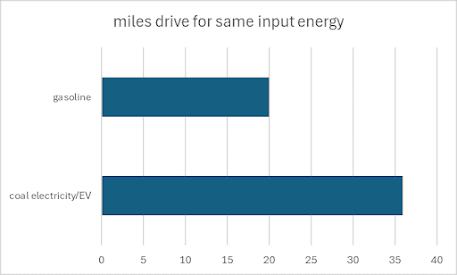
So, for the same energy input,  the EV can go 80% farther.


Put another way, the input energy it takes to move an EV 36 miles, if electricity is from coal plant, will only moves a gasoline car 20 miles.

Now, let's talk CO2.  Coal has 40% more carbon than gasoline per unit of energy.  So, for the power plant, 100 of coal in gets me 100 CO2 out the stack.  Gasoline,  100 energy in gets me 70 CO2 out the tailpipe.  Plug and chug...

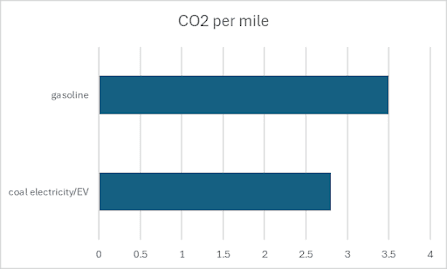
100 CO2/36 miles = 2.8 CO2/mile for coal/EV combo
70 CO2/20 miles = 3.5 CO2/mile for gasoline car.


My coal-fired EV goes 80% farther and emits 20% less carbon per mile!

Let's add in one more thing.  Regenerate braking.  I have some stats that show in suburban Atlanta driving, about half the energy it takes to propel the car is recoverable when braking.  That is, instead of burning off kinetic energy with brakes, an EV can use the motors as generators and put that energy back into the battery.

So, half the energy it takes to move me 36 miles is recovered when I stop, enough to move me another 18 miles.  Plug and chug...

54 miles vs. 20 miles. 


100 CO2/54 miles = 1.9/mi
70 Co2/20 miles =3.5/MI


270% farther with 46% less CO2/mi.

But, what about cost?  Okay. 

A typical EV goes 3 miles on a KW-HR of electricity. At home, that costs about 12 cents. That's 4 cents a mile.

A typical gasoline car gets 25 mpg.  At $3/gallon, that's $0.12/mile.

Over 20,000 miles, the EV saves you $1,600 per year in "fuel". But, EVs cost more to buy, right?  Yes, for similar sized SUVs, the EV costs $14k more,  After the $7500 US rebate, the net is about $7000, so simple payback is about 4 years.

But, if all of this is so, why didn't we have EVs decades ago?  The simple answer is technology.  There are two and two half big pieces I see.  

One is battery energy density.  Lithium Ion batteries are currently the top of the heap and have just enough energy density by size and weight to make a practical car.  It's only been a bit over a decade that practical batteries have been doable.  Note, that we are nowhere near the end of battery evolution.   It seem that about once a month there is news about battery chemistry advancement.

Two is high power solid state invertors that can turn battery DC voltage into variable frequency AC to power the motors.  These two pieces are the key.  We don't have these, we don't have EVs.  These were developed and matured in the 1990s and early 2000s and are in just about everything these days from phone chargers to locomotives. 

One "half piece" is rare earth magnets for the permanent magnet motors.  These make small, high torque, high power motors possible.  There are alternatives, but these really make things simpler and easier.  Rare earth magnets are pretty cheap these days-you even see them replacing pins and hasps in cheap jewelry.

The other "half piece" is computer power.  The complexity of EVs is in the computers and software that control the battery and propulsion. Fast, powerful computing makes them run well.  

There are many other factors that need to be considered to get the whole picture of EVs vs gasoline, but most of these, like mechanical simplicity, battery technology growth and longevity tilt in the favor of the EV and require a better treatment than just this post.

Energy is the big one.  EVs have won that game already.  The conversion will happen.  The only question is how fast.  The government is subsidizing the conversion speed to try to meet climate goals, but even without them, the conversion will occur.


Wednesday, April 24, 2024

The Keys Hit All the Right Notes

 We took a trip to Key West.  

The African Queen.  Really.


On the African Queen?  Well, no.  But, it is a sight you can see on the drive down.  Why did we go?  Bucket list trip for FIL, return trip for us. Our first trip, 14 years ago, was cold and rainy.  We wanted to see if it actually was a sub-tropical paradise.  So, off we go.  We drove down to Homestead the night before in order to have a whole day to drive the route down to Key West.  We spooled up a GuideAlong tour (https://guidealong.com/tour/miami-key-west-florida/) and headed down the highway.  "Gary" did not disappoint.
After stopping by to see the African Queen - original from the Bogart /Hepburn movie of the same name - we stopped at a place called Robbie's  - to feed Tarpon...and Pelicans.

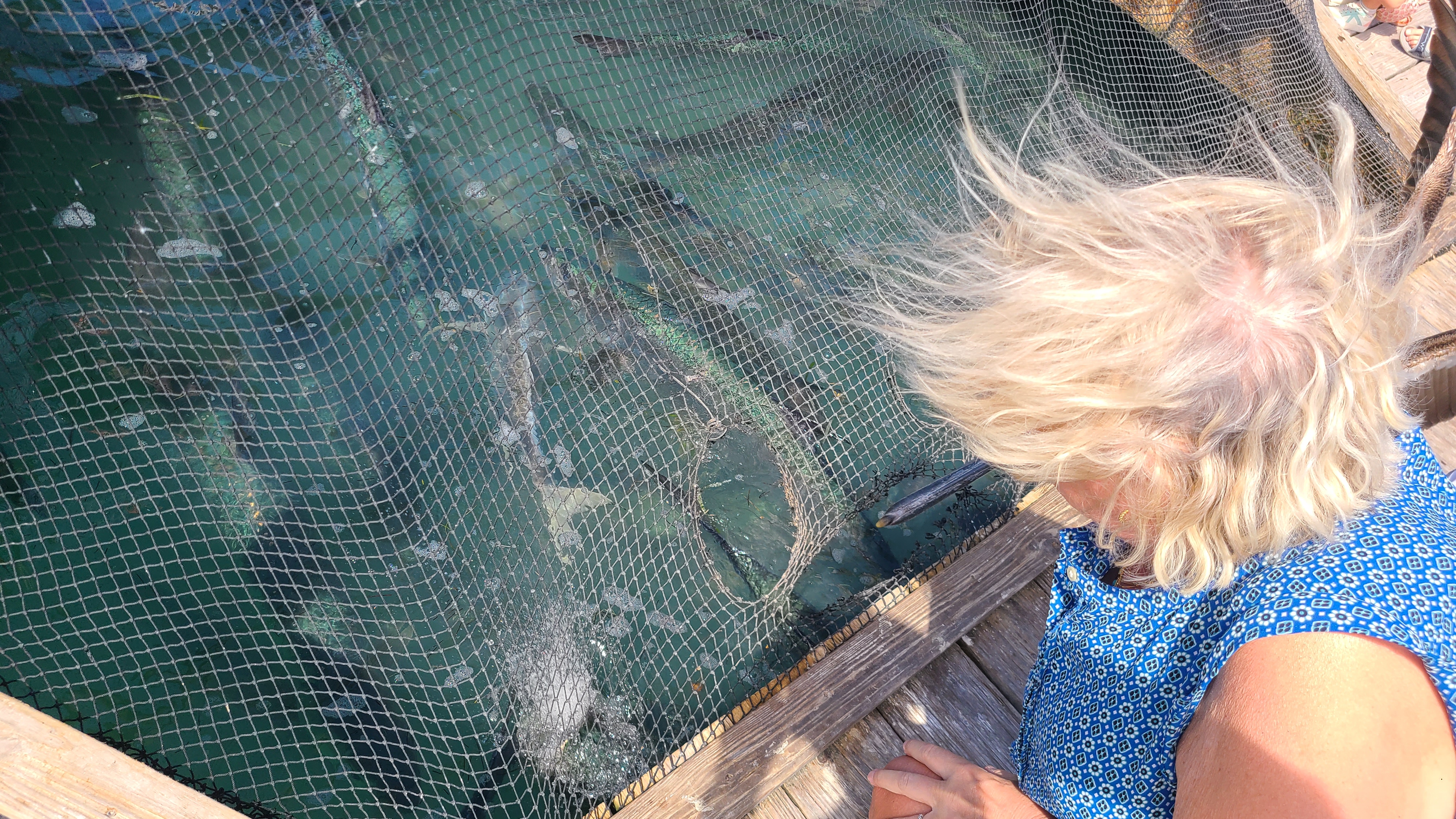
Big fish and pelicans and people at Robbie's

Who's looking at who?

The "let's get some bait" lady.  We didn't know it was dead fish in a bucket.


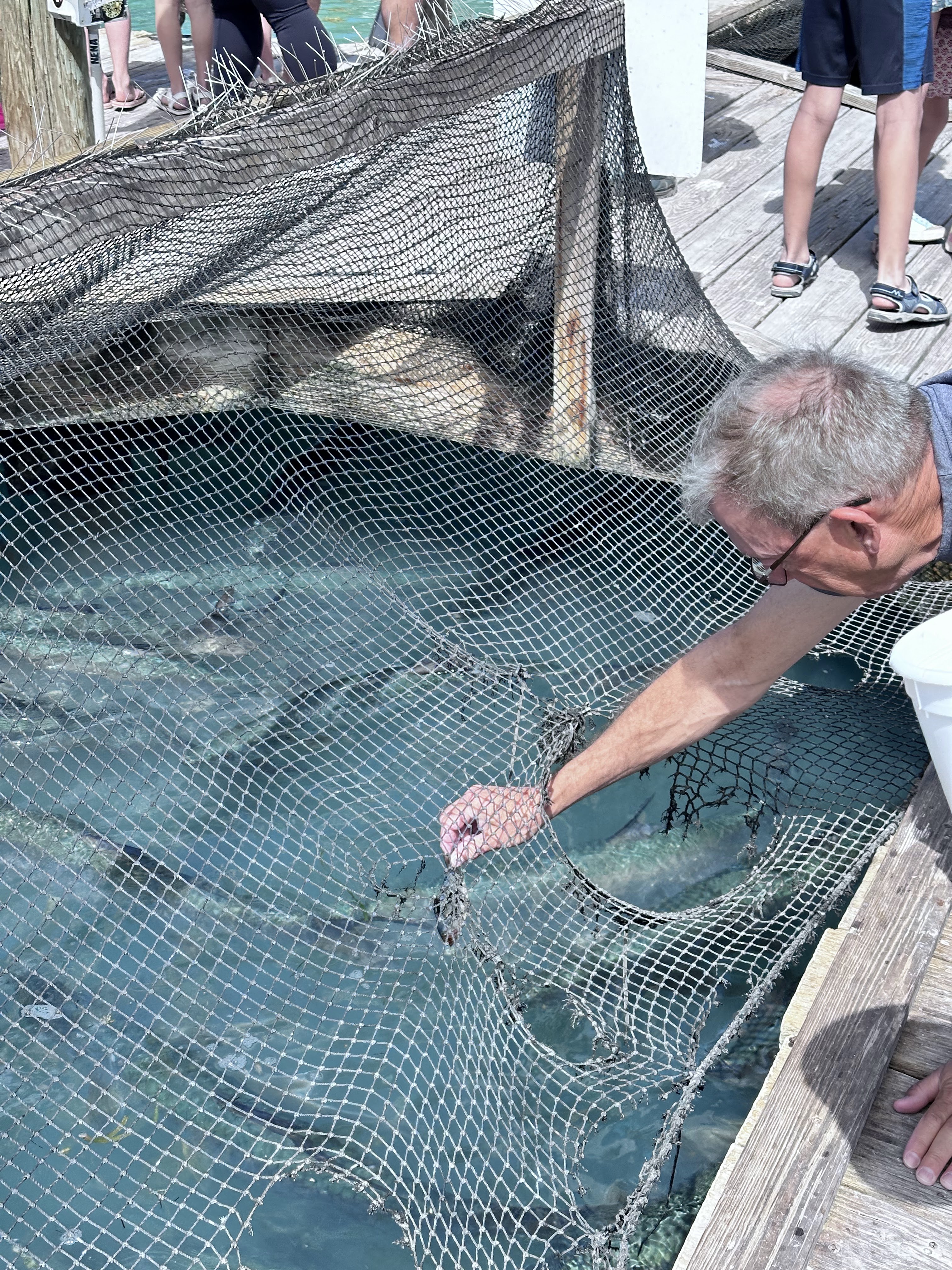
You dangle the dead fish and the tarpon jumps out of the water to snatch it.  They warn the tarpon can bite.  So, I flinch when then jump and drop the fish - almost always missing the tarpon's mouth.  I wanted to watch.  Somehow, I got to be the "doer".
 

While you try to feed the tarpon, the pelicans try to steal your bait.  Except, there is no try.  There is only do.  They do steal your bait - agressively!

Pelican stole fish from Patti - and tried to steal a couple fingers as well.


The bucket is empty, now.  The pelicans, apparently, are not.

That was Robbie's.  What's next?

A giant fiberglass spiny lobster!

Obligatory selfie.


We got down to the bottom of Marathon Key and were hungry for lunch.  "Gary" had a great recommendation.  Fresh fish.  Key Fisheries restaurant.  Open air picnic tables overlooking marina.


The real beauty of the Overseas Highway, is the scenery.  The highway is the second iteration of the route.  Key West was first connected to the mainland by the Florida East Coast Railway in 1912.  Henry Flagler was a man who made his first fortune as a Standard Oil founder.  He made his second by building the Florida East Coast Railway and is responsible for the development of the entire Florida eastern seaboard in the late 19th century.  

Henry
His "last act" was to build the Key West Extension from Miami.  It was completed in 1912 and terminated in Key West at a rail ferry terminal designed to tap into passenger and freight traffic from Cuba and the surrounding Gulf of Mexico.  It saved days of transportation time from the water route to east coast ports.  It consisted of  a series of long bridges and viaducts over the water, joining adjacent Keys.  A year after it was completed, Henry died. 

The route was marginally successful, at first.  But, the depression destroyed the leisure travel and goods trade with Cuba.  A hurricane in 1935 destroyed a chunk of the route.  The Florida East Coast Railway was already in bankruptcy at the time, and sold the route to the state.  The federal government converted it to a highway in 1938, repairing and using the rail bridges.

In the 1970s and 80s, a new, modern two lane road replaced the converted railroad right of way although many of the original bridges remain and have been converted into paths and fishing piers.

Old and new 7 mile bridge.  The longest.  Notice how they used repurposed rail for guardrail when converting the bridge.

Bahai Honda bridge...

...now a state park.  You can walk on part of it.


Finally, we arrived at Key West.

Mallory Square.

Day one.  Sightseeing.  First stop, the Truman place....and a guided tour.  Harry stayed here quite a few times during his presidency.  


Harry himself?

His working desk

The living room with tour group.


Lunch at Sloppy Joes, of course!  


Then down the street to the Hemmingway house and another guided tour.

The house

The annex with infamous pool and his writing studio above.

His man-cave writing studio.


Six toed cat?

Across the street is the lighthouse, complete with keepers house and grounds.  Worth the admission - you can climb to the top.


Spiral staircase not along the wall!

From the top!

A few blocks away, is the southern most spot in the continental US....or close enough, anyway.  There was a line, but finally a picture!

 
The line

The scene.


Ta-dah!


Dinner that night was beach-front restaurant that served lobster pizza!  Had to try it.  It was very good!


The second day was boat day. As in, taking a boat to the Dry Tortugas National Park!  A long day.  Check in at 7:00AM.  Board at 7:30.  Arrive Dry Tortugas at 10:30.  

Bagels, coffee and soda for breakfast on the way out.  Oh, and a nap!


The bridge of the Yankee Freedom III


Mostly smooth sailing on the way out.  

Loggerhead Lighthouse on Loggerhead Key

Arriving Fort Jefferson


Dockhouse and dock at the right.  Remnants of south coal pier in foreground.

Yankee Freedom III as viewed from the moat


The Dry Tortugas include Fort Jefferson.  The largest coastal defense fort built by the US.  The trip included a walking tour of the fort. 

Ship crewman "Hollywood" led the tour.  He was knowledgeable and passionate and a good story teller.


The fort was part of beefing up coastal defenses after the War of 1812 where Washington DC was invaded and the White House burned to the ground.  The Third System of Defense ( Wiki Third System of Forts ) was built to make the country more secure.  Most forts were built in places where they could receive support from adjacent ones up and down the line, but Fort Jefferson could not.  It was 70 miles by sea from the next closest in Key West and it was the last in the line, so only had support from one side.  So, it was sized to be self-supporting for a siege up to a year long.  Located on the key spot on the route between the Mississippi and the East Coast, as well as where all western Caribbean traffic funneled to catch the Gulf Stream to Europe and the only place for miles with deep water shelter, the location was one that needed be unquestionably defended.  Fort Jefferson is just plain huge.


Second tier gun gallery.  Plan was for 150 guns on each tier.

Rodman cannon on third tier bastion.

Finished gun emplacement on first tier.

Each gun emplacement had Hallet shutters to shield gun crew from incoming fire.  They automatically opened and shut.  (originals all removed because of deterioration from rust.  These are non-ferrous replicas)

The fort was never finished.  The second tier was roughed in, but gun ports never completed.  The construction was so heavy, it started subsiding even before all the concrete and brick were in place.  

The fresh water collection system was a failure, so sea water distillation boilers were installed.  The fort required coal to fire the boilers, so two coal piers were built.  

North side coal pier.  (not the fool in the water, the thing behind him)


After, we walked the moat, flew a kit (or tried),  waded in the water and watched the birds fly about.  We could have snorkeled, but the water was, um, "cool" (76 degrees...) and a bit cloudy from the recent weather.

Kite flying

Magnificent Frigate birds (their actual name!)


Nesting birds of some kind I'm too lazy to look up.

Birds on Bush Key.  Probably including Black Noddies.


In the water

The moat

Moat walkers

Moat near North Beach

More moat.  Near South Beach.

The boat boarded at 2:45 and departed at 3:00 with a 5:00 PM arrival back into Key West.  Seas were a bit rougher on the way back, but Dramamine is always your best boat buddy, and it was a fun trip bouncing over the waves.


Arriving Key West

The only day Key Lime Pie wasn't desert.  Chocolate for Helen Horan to remember her birthday.


The third, and final day, in Key West, we visited the local Navy bases just to see what they looked like, plus a few other sights we missed the first day.

Fort Zachery Taylor.  Another fort in the "Third System".  Modernized through the years, then turned into a junk yard by the Navy, then abandoned.  Dug out in the second half of the 20th century and restored.  Now a State Park.


Original gun port design identical to Fort Jefferson.

On the top of what once was the second tier.

Modernized gun emplacement

Overview

Lunch at Blue Heaven.  Worth the wait! Excellent food.  Nice courtyard.


The upstairs used to be a brothel.

Lunchtime!

Where Hemmingway's boxing ring got hauled off two after his wife built a spiteful, expensive swimming pool in it's place with his "last red cent".

And, finally, some things that we just liked, thought, fun or funny, or just plain weird.

The number one plumber on the island.  Obviously.

Pretty good local beer.

St. Paul's Episcopal Church

...yes...

Evening at Mallory Square

Customs House


Kapok Tree

Goes with Patti's The Plumber?

Bight scene with pelicans

The claim or the host.  Which is weirder?

Gary is everywhere.

Conch Republic Lives!


Key West is roosters everywhere!

Just a cool mural.


The last night, we hunted a sunset spot and had dinner.  A small, outdoor bar and grill on a Navy base was the winner.  Sunset Lounge on Dredger's Key.


And with that, our Key West adventure was over.